
S&P Projects Stable Indonesian Credit, Market Awaits Economic Improvement
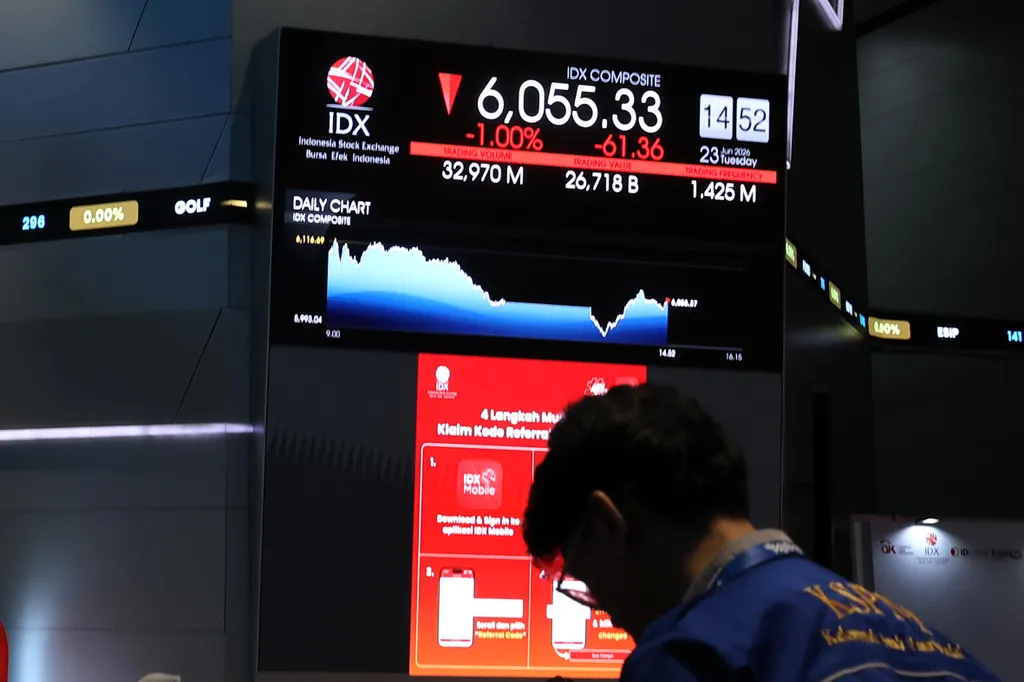
The Financial Services Authority (OJK) has welcomed the decision by Standard & Poor’s (S&P) Global Ratings to maintain Indonesia’s credit rating at BBB with a stable outlook. The authority has pledged to strengthen the financial markets, whilst the markets await the economic improvements that have been in the spotlight since the start of the year.
In its report, S&P Global assessed that Indonesia’s economic fundamentals will remain stable going forward, supported by robust domestic demand, prudent fiscal policy, and a credible and flexible policy framework for maintaining macroeconomic stability.
In line with this, the Chair of the OJK Board of Commissioners, Friderica Widyasari Dewi, said in a press release on Tuesday (14 July 2026) that the OJK will continue to pursue various measures to strengthen the financial services sector.
The OJK is committed to strengthening risk-based integrated supervision, deepening the financial markets, improving market integrity and governance, and accelerating digital transformation in accordance with the Law on the Development and Strengthening of the Financial Sector (UU P2SK).
According to Friderica, these efforts are being undertaken to expand the financial sector’s capacity to mobilise long-term financing for businesses and national development.
“These steps also support Indonesia’s strategic programmes, including increasing investment, economic transformation, and strengthening national competitiveness,” said Friderica.
She added that the national financial services sector remains in stable condition, supported by strong capitalisation, adequate liquidity, a well-maintained risk profile, and continuously developing intermediation functions, enabling it to support financial system stability and the financing of the economy.
As part of the Financial System Stability Committee (KSSK), the OJK will continue to strengthen synergy with the government, Bank Indonesia, and the Deposit Insurance Corporation (LPS) to maintain financial system stability and support Indonesia’s economic growth.
On the other hand, asset management firms such as Manulife Investment consider Indonesia’s financial markets to remain uncertain. Luke Browne, Global Head of Multi-Asset Solutions at Manulife Investment, said during an online presentation of the firm’s second-half 2026 outlook for Asian financial markets on Tuesday that Manulife has downgraded its recommended allocation to Indonesian financial assets to underweight.
An underweight status is a recommendation for investors to reduce the proportion of a share or asset in their portfolio. This rating is given when a financial asset is projected to perform worse than the average of comparable market or sector indices over a certain period. The opposite recommendation is called overweight.
Browne explained that the recommendation was not based solely on the firm’s fundamental view, but also took into account the concerns of a number of international rating agencies regarding Indonesia’s market status, including S&P, Moody’s, and Fitch Ratings.
Nevertheless, he sees an opportunity for Indonesia to return as a top choice if the government and regulators can address these various concerns.
“I see Indonesia could return to overweight if the regulators and the government are able to resolve the various concerns raised by the rating agencies, and there are already indications in that direction,” he said.
Similarly, June Chua, Head of Asia Equities at Manulife Investment, said on the same occasion that the government’s recent response has begun to send positive signals.
“Investors are indeed still in a waiting position, but Indonesian equity valuations have become very attractive and offer significant upside potential if sentiment improves,” she said.
Given these conditions, Manulife believes that the prospects for Indonesia’s financial markets for the remainder of 2026 will depend heavily on the restoration of investor confidence and the consistency of government policy.