
S&P Maintains Rating, Is Investment in Indonesia Still Safe?
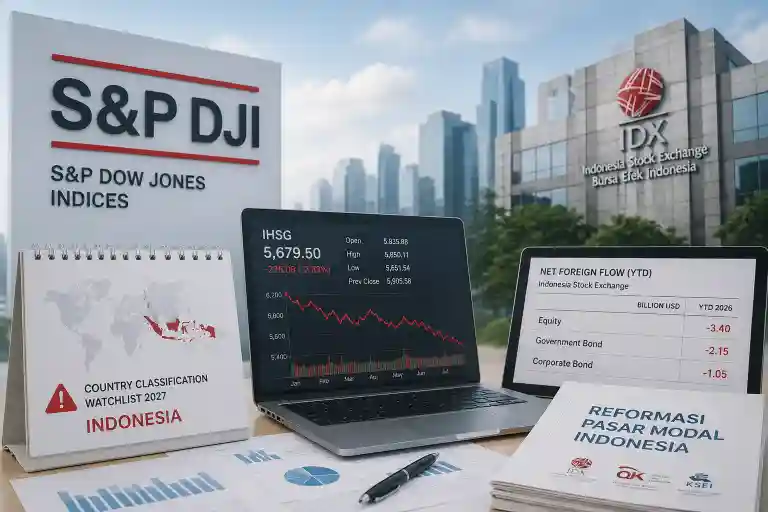
The decision by S&P Global Ratings to maintain Indonesia’s sovereign credit rating at BBB for the long term and A-2 for the short term is a positive signal for the domestic financial market amid rising global uncertainty. The affirmation, announced on Monday, 13 July 2026, confirms that Indonesia remains in the investment grade category, or worthy of investment. S&P also maintained a stable outlook, indicating the rating agency does not foresee fundamental changes that could shift Indonesia’s risk profile in the near term.
Behind the decision lies a significant message. S&P acknowledged that Indonesia is currently facing pressures, both fiscally and in the external sector. The rupiah exchange rate has weakened, fiscal space is challenged by rising government spending, and the global economy remains overshadowed by a slowdown and geopolitical uncertainty. However, S&P assessed that these pressures have not fundamentally altered Indonesia’s economic foundations. The agency views the weakening as temporary and still manageable, supported by several buffers from domestic conditions and global commodity market dynamics.
One factor of note is the outlook for commodity prices. Indonesia remains significantly dependent on commodity exports, ranging from coal and palm oil to nickel and various other mineral products. When commodity prices are at relatively high levels, state revenue has the potential to increase through taxes, royalties, and non-tax state revenue. Export performance also receives support, helping to maintain external sector balance. This condition is considered one of the cushions for the Indonesian economy when global pressures intensify.
Beyond the commodity factor, S&P also highlighted the government’s steps in maintaining fiscal discipline. The efficiency policies on spending that have begun to be implemented are seen as helping to control pressure on the state budget amid the increasing financing needs of various strategic programmes. For international rating agencies, fiscal discipline is a key indicator in assessing a country’s ability to meet its debt obligations. Therefore, the spending efficiency measures are viewed as a factor supporting medium-term fiscal stability.
S&P also maintained its projection for Indonesia’s economic growth at around 5 per cent per year over the next two to three years. This projection reflects confidence that domestic economic activity still has resilience, despite facing pressure from the global economic slowdown. Technically, a BBB rating indicates Indonesia has adequate capacity to meet long-term debt obligations, while the A-2 rating reflects good ability to meet short-term financial commitments. The combination of these two ratings keeps Indonesia in the group of countries considered to have relatively well-maintained investment risk.
Investment grade status holds significant importance for financial markets. Many global institutional investors, such as pension funds, insurance companies, and international investment managers, have internal policies that only permit investment in countries or instruments that have obtained an investment-worthy rating. With the rating maintained, Indonesia remains within the group of countries meeting the investment criteria for various global financial institutions. The decision also provides certainty that, to date, there has been no decline in the country’s credit quality according to S&P’s assessment.
The market response to the announcement appeared quite positive. After the decision was announced, the Jakarta Composite Index (IHSG) strengthened by up to 1.92 per cent to a level of 6,037.84. The strengthening occurred as market participants responded to the certainty that one of the world’s largest rating agencies still maintains a positive assessment of Indonesia’s ability to manage fiscal and economic conditions.
Nevertheless, the S&P decision does not mean all economic challenges are over. Indonesia still faces a number of tasks, from maintaining rupiah exchange rate stability and controlling the fiscal deficit to boosting investment and strengthening export competitiveness amid global trade dynamics. Furthermore, international investor attention to financial market reform continues. In recent weeks, several global index providers such as MSCI and S&P Dow Jones Indices have continued to scrutinise various aspects of Indonesian capital market governance, including share ownership transparency and trading liquidity. In this context, S&P Global Ratings’ decision to maintain Indonesia’s credit rating serves as a signal that, in terms of the country’s ability to meet its financial obligations, the national economic fundamentals are still considered adequate. The assessment is supported by a combination of stable economic growth prospects, potential support from the commodity sector, and the government’s commitment to maintaining fiscal discipline through spending efficiency. Going forward, consistency in implementing fiscal policy, macroeconomic stability, and the ability to maintain growth momentum will be factors that rating agencies and global investors continue to monitor.