
Russia’s S-400 Poses a Challenge as France Prepares New Weapons
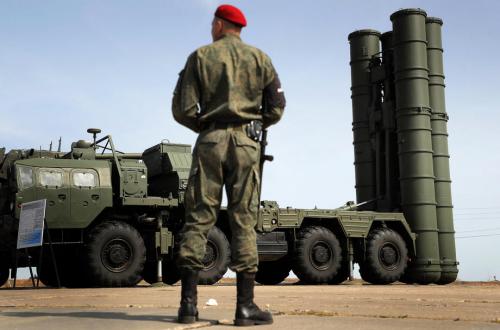
JAKARTA — France is preparing new weapons to restore its air force’s ability to counter modern air-defence systems, including the threat posed by Russia’s S-400. The move comes after the French military acknowledged that it had given up specialised capabilities to destroy enemy radar in the late 1990s—a decision now seen as a strategic weakness amid the growing risk of high-intensity warfare in Europe.
The issue returned to the spotlight after German outlet FOCUS Online reported on Thursday (22 October 2026) that the French Air and Space Force plans to use AASM Hammer 250 XLR long-range guided bombs. With a projected range of about 140 kilometres, the weapon is expected to enter service in 2028 as an interim solution until France acquires the Stratus RS supersonic missile in the following decade.
Earlier, military aviation outlet The Aviationist reported on 19 October 2026 that France was seeking to restore its ability to attack enemy air defences using guided weapons powered by small jet engines. The report cited remarks by Air and Space Force Chief of Staff General Jérôme Bellanger during a hearing at the French National Assembly on 14 October 2026.
Bellanger acknowledged that France once had a specialised capability to suppress and destroy enemy air defences using Jaguar attack aircraft and AS-37 Martel anti-radiation missiles. However, that capability was abandoned in the late 1990s and was not promptly replaced by a dedicated weapons system with a similar role.
According to Bellanger, the ability to suppress enemy air defences is an important element of fighter operations. The need to restore it has become more urgent as air superiority can no longer be taken for granted in modern armed conflict.
Russia’s S-400 among the threats considered
Russia’s S-400 air-defence system is one example of a threat specifically discussed in French assessments of its weapons requirements. The issue arose in a written question submitted by French National Assembly member Marc Chavent to the Ministry of the Armed Forces on 3 March 2026.
Chavent drew attention to the French military’s reliance on United States support when confronting layered air-defence networks. He cited a scenario involving Russia’s S-400 and an Airborne Warning and Control System (AWACS) aircraft to illustrate the difficulties French fighters could face.
In his question, Chavent described a scenario that he said had been simulated by NATO, in which a combination of S-400 and AWACS could detect and track approaching aircraft from more than 400 kilometres away. This was a scenario put forward by the MP, however, rather than the result of a live test proving the capabilities of every S-400 configuration in all combat situations.
The S-400 Triumf is a Russian long-range air-defence system designed to counter a range of aerial threats, including fighter aircraft and certain types of missiles. It can operate as part of a layered defence network involving surveillance radars, command systems, missile launchers and other supporting equipment.
Such networks can complicate fighter operations because threats may come from different directions and at varying ranges. Aircraft seeking to strike targets in enemy territory must also take into account surveillance, electronic warfare and the possible presence of additional air-defence systems.
The French government responded to Chavent’s question in an official reply published on 7 July 2026. The Ministry of the Armed Forces said France had chosen to develop its own capability through the Stratus Rapid Strike, or Stratus RS, project, reducing its reliance on specialised US weapons.
The government’s response said Stratus RS was designed to carry out long-range missions to suppress and destroy enemy air defences. The system will also have an anti-ship role and is planned to become part of the weapons suite for the next generation of Rafale fighter aircraft.
Nearly three decades without anti-radiation missiles
France’s capability gap began when the AS-37 Martel anti-radiation missile was withdrawn from service in the late 1990s. A report by the French National Assembly’s Defence Committee, published on 29 October 2025, said the specialised capability had been abandoned in 1997.
The Martel missile had been part of the French Air Force’s offensive electronic-warfare capability, alongside radar jammers and electromagnetic decoy systems. These weapons were used against enemy air-defence radars, enabling fighter aircraft to conduct strike missions with reduced risk.
The capability was used in a real military operation when France attacked Libyan radar installations in Chad in 1987. According to the French parliamentary report, Martel missiles were used to destroy a Flat Face surveillance radar at Ouadi Doum airbase.
The end of the Cold War, however, prompted a shift in Paris’s defence priorities. France focused more on nuclear deterrence, expeditionary operations and deploying military forces in conflicts that did not always involve large numbers of modern air-defence systems.
That decision left a gap in the capabilities known as Suppression of Enemy Air Defences (SEAD) and Destruction of Enemy Air Defences (DEAD). Both types of operation aim to suppress, disable or destroy an adversary’s air-defence assets so that fighter aircraft can enter areas that would otherwise be too dangerous to penetrate.
France has not entirely lost the ability to attack air-defence installations. Its air force still uses SCALP cruise missiles, AASM Hammer guided bombs and electronic-warfare equipment that can support operations against such targets.
The issue is that these weapons were not specifically designed to meet the full range of SEAD and DEAD requirements when facing a complex air-defence network. France is therefore now seeking to rebuild a dedicated capability that it considers increasingly important in modern warfare.
Source: jawawa.id (https://jawawa.id/newsitem/russias-s-400-poses-a-challenge-as-france-prepares-new-weapons-1792659079)
Originally published by Republika (https://news.republika.co.id/berita/tnar7s451/s400-rusia-jadi-tantangan-prancis-siapkan-senjata-baru), translated from Indonesian