
Russia’s S-400 Keeps Turkey from Buying 40 US F-35s, While Iran Seeks the System
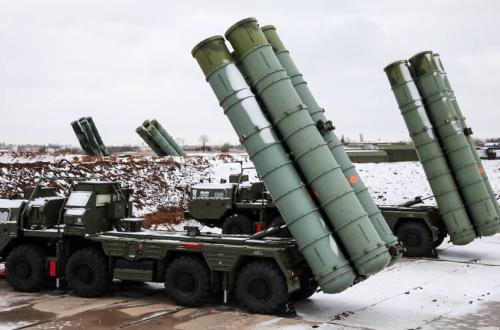
JAKARTA — Russia’s S-400 Triumf air-defence system has once again become a source of geopolitical friction involving the United States, Turkey and Iran. Ankara continues to face legal obstacles to buying 40 F-35 Lightning II stealth fighters from the United States because it owns the S-400, while Tehran has reportedly asked Moscow to supply the system to strengthen its territorial defences.
The latest development came after Iran’s Supreme Leader Mojtaba Khamenei sent Mohsen Rezaei, secretary of Iran’s Supreme National Security Council, to meet Russian President Vladimir Putin at the Kremlin on Thursday (5 November 2026). Rezaei carried a personal letter from Khamenei which, according to The Telegraph on Friday (6 November 2026), requested that Russia supply S-400s to Iran.
Citing an unnamed senior Iranian official, The Telegraph reported that Tehran was optimistic Putin would approve the delivery of the air-defence system, which Iran has sought for a long time. However, as of 8 November, there had been no official confirmation of a contract being signed or a delivery schedule for S-400s to Iran.
Russia’s TASS news agency confirmed on Friday (6 November 2026) that Putin had received a letter from Khamenei through Rezaei. The Kremlin said the meeting covered strengthening the Russia-Iran strategic partnership and security developments in the Persian Gulf and the Middle East, but did not disclose any agreement to procure S-400s.
Iran’s Tasnim News Agency also confirmed the meeting. According to Tasnim, Rezaei conveyed Khamenei’s message to Putin and discussed regional security arrangements following the war involving Iran, the United States and Israel. In addition to security matters, the two sides discussed the construction of a Russian gas pipeline to Iran.
The contrast between the official accounts from Moscow and Tehran and The Telegraph’s report is significant. Both countries confirmed the Putin-Rezaei meeting, while the specific request for S-400s remains based on a media report citing an anonymous Iranian official.
The situation highlights the divergent positions of two countries that both have defence ties with Russia. Turkey, a member of the North Atlantic Treaty Organisation (NATO), is seeking to resolve the issue of its S-400 ownership so it can obtain F-35s from the United States. Iran, by contrast, has reportedly sought S-400s to improve air-defence capabilities damaged by US and Israeli attacks.
Turkey wants 40 F-35s but is blocked by US law
Turkey’s dispute began in 2017, when President Recep Tayyip Erdogan’s government decided to buy S-400s from Russia. Ankara took the step after its efforts to secure a US-made Patriot air-defence system failed to produce the agreement it wanted.
According to Russia’s TASS news agency, Turkey’s S-400 purchase contract was worth about US$2.5 billion. Delivery of the first components began in July 2019, and Russia later said it had completed its delivery obligations under the contract.
Ankara’s decision prompted a strong response from Washington. On 17 July 2019, the US Department of Defence announced the process of removing Turkey from the F-35 fighter development and production programme.
Turkey had previously been one of the international industrial partners in the fifth-generation aircraft programme. Turkish defence companies manufactured various F-35 components, while Ankara had initially planned to buy up to 100 aircraft.
Washington argued that operating S-400s in a country that also had F-35s could allow Russia to obtain sensitive information about the stealth aircraft’s radar characteristics.
The Pentagon said that the collection of F-35 radar data and flight information by a Russian air-defence system could pose a risk to the aircraft’s technological security.
Turkey has repeatedly rejected US concerns. Ankara says the S-400 can be operated independently, without being integrated into NATO’s air-defence network. Erdogan’s government has also offered to establish a technical commission to examine the issue.
Washington’s objections, however, went beyond technical debate. The US Congress subsequently passed legal restrictions that directly prevent the transfer of F-35s while Turkey owns the S-400.
A Congressional Research Service (CRS) report published on 14 July 2026 confirmed that Turkey is now seeking to buy 40 F-35 Lightning II jets while also having sanctions under the Countering America’s Adversaries Through Sanctions Act (CAATSA) lifted.
The 40-aircraft figure is the latest request recorded by the CRS and differs from Turkey’s original plan to acquire about 100 F-35s before it was removed from the programme in 2019.
Turkey also plans to acquire 40 new F-16 aircraft from the United States. Although the number is the same, the F-16 package is a separate procurement and should not be confused with the request for 40 F-35s.
Trump opens the door, but the US Congress remains an obstacle
Ankara’s hopes of regaining access to the F-35 briefly rose after US President Donald Trump said in July 2026 that he was willing to consider selling the aircraft.
At a NATO summit in Ankara on Tuesday (7 July 2026), Trump told Erdogan that his administration would move to lift sanctions against Turkey. He also raised the possibility of an F-35 sale.
But Trump’s political statement does not automatically remove the restrictions imposed by Congress.
A CRS report dated 20 August 2026 said Section 1245 of the National Defence Authorisation Act for Fiscal Year 2020 continues to restrict the transfer of F-35 aircraft to Turkey.
The law provides a mechanism for an exemption, but requires the US government to certify that Turkey no longer possesses S-400 systems or related equipment, guarantees that it will not receive the system again, and meets additional requirements concerning the procurement of defence equipment from Russia.
A US State Department letter to Congress dated 22 July 2026, obtained by the Greek newspaper Kathimerini, stated that Ankara had not yet met the legal requirements for obtaining F-35s.
Turkey’s obstacle is therefore not simply Washington’s diplomatic opposition. It must also meet statutory requirements, even if the US president expresses support for restoring defence cooperation.
President Erdogan has described Turkey’s removal from the F-35 programme as unjust. In remarks reported by Anadolu Agency on 5 January 2026, he said receiving the aircraft that Turkey had paid for and returning to the F-35 programme were important to strengthening NATO’s defence capabilities.
Turkey’s Foreign Minister Hakan Fidan later explained that Ankara distinguishes between lifting the ban on F-35 sales and restoring its status as a production partner. According to Fidan, the two issues require separate processes and decisions.
Source: jawawa.id (https://jawawa.id/newsitem/russias-s-400-keeps-turkey-from-buying-40-us-f-35s-while-iran-seeks-the-system-1794203475)
Originally published by Republika (https://news.republika.co.id/berita/to7x1z451/gegara-s400-rusia-turki-terhalang-beli-40-jet-f35-as-iran-justru-mengincarnya), translated from Indonesian