
Russia’s Missile Barrage Puts Ukraine’s Air Defences Under Strain
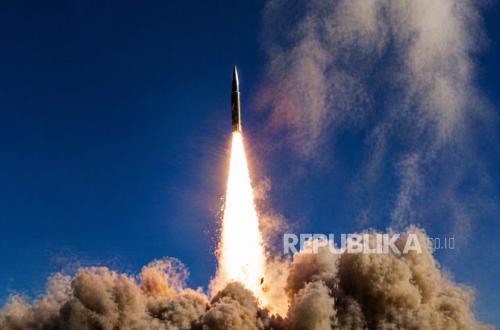
Russia is increasing pressure on Ukraine’s air defences through layered attacks combining Iskander-M ballistic missiles, Zircon missiles and various types of drones. The attacks are not only testing Kyiv’s ability to destroy airborne targets, but also depleting its stocks of interceptor missiles, which are becoming increasingly difficult to obtain.
The latest pressure was seen in an attack on the Ukrainian capital from Wednesday night (21 October 2026) into the early hours of Thursday (22 October 2026). Russia launched at least 21 ballistic missiles in three waves against Kyiv, according to Ukrainian President Volodymyr Zelenskyy, as reported by Reuters.
The attack came as diplomatic efforts to end the war were again under discussion. However, the intensity of both sides’ air operations has not shown signs of easing.
The Associated Press reported that Russian missile strikes on Kyiv killed at least four civilians and injured dozens, including children. Several buildings were damaged by direct hits and falling debris.
The attack on Kyiv illustrates the increasingly difficult challenges facing Ukraine’s air defences. Although the country has received advanced defence systems from Western nations, its ability to deal with large numbers of ballistic missiles remains heavily dependent on the availability of interceptor missiles.
The problem is that Russia is not relying on just one type of weapon. In attacks throughout October, Moscow has used a combination of ballistic and cruise missiles, anti-ship missiles directed at land targets, attack drones and decoy drones.
This strategy forces Ukraine to counter threats travelling at different speeds and altitudes and following different flight paths, often almost simultaneously.
Iskander and Zircon in a major attack
One attack that demonstrated the complexity of the threat took place on 14 October 2026. According to Ukrainian media outlet The New Voice of Ukraine, citing the Ukrainian Air Force, Russia launched 167 aerial attack assets in a single night.
The total included 128 drones and 39 missiles of several types, including Iskander-M, KN-23, S-400 missiles used in a ground-attack role, Zircon and Onyx.
Ukraine’s air defences reportedly neutralised 119 targets. However, this figure combines different types of threats and cannot be used to determine the interception success rate against ballistic missiles specifically.
That distinction matters because the ability to destroy drones is not the same as the ability to intercept ballistic missiles.
Attack drones generally fly much more slowly and can be countered using a combination of anti-aircraft weapons, electronic warfare systems and interceptor drones.
By contrast, ballistic missiles travel at very high speeds, giving air-defence operators far less time to react.
The Iskander-M is one of Russia’s main weapons for attacking high-value targets in Ukraine.
The short-range ballistic missile system is designed to strike ground targets along a trajectory that makes interception difficult. The missile can manoeuvre in flight and employ various measures to reduce the effectiveness of enemy defences.
These characteristics make the Iskander-M a serious threat to military facilities, energy infrastructure and other strategic targets.
The Zircon, or 3M22, is a missile that Russia classifies as a hypersonic weapon.
Originally developed to attack maritime targets, it has also reportedly been used against targets on Ukrainian territory.
Zircon has a different flight profile and speed from a subsonic cruise missile. Its combination of high speed and flight characteristics can narrow the window for air defences to detect, track and intercept it.
However, claims about Zircon’s maximum speed and manoeuvring capabilities should be distinguished from test and combat results that can be independently verified.
The use of a hypersonic missile does not mean that it is impossible to destroy. Ukraine has reported intercepting several Zircon missiles.
Ukraine’s Ministry of Defence said that eight Zircon missiles were intercepted during September 2026. This is an official Ukrainian account and individual interceptions have not been independently verified.
Why Patriot is so important
Ukraine’s main problem is not simply a shortage of air-defence systems, but a lack of weapons capable of countering ballistic threats.
Kyiv operates several air-defence systems from different countries, including Patriot, NASAMS, IRIS-T and short-range defence equipment.
Each has different roles and capabilities.
Systems such as NASAMS and IRIS-T are crucial for countering aircraft, drones and some types of cruise missile. However, those capabilities do not automatically make them substitutes for Patriot when confronting tactical ballistic missiles such as the Iskander-M.
To counter high-speed ballistic threats, Ukraine relies heavily on Patriot systems equipped with suitable interceptor missiles.
That dependence becomes a problem when Russia can launch many missiles in one wave while Ukraine’s interceptor stocks are limited.
An investigative report by Reuters on 18 September 2026 revealed that Ukraine was facing a serious shortage of Patriot interceptor missiles.
The shortage comes as demand for air-defence weapons is rising in various regions around the world.
The United States must meet its own military needs while also responding to requests from allies in the Middle East and elsewhere.
As a result, supplies of interceptor missiles to Ukraine face competing priorities and limited production capacity.
The shortage of ammunition can have direct consequences on the battlefield.
An air-defence system that is technically capable of destroying ballistic missiles cannot perform effectively if the required interceptor missiles are not available in sufficient numbers.
Ukraine’s air-defence problem, therefore, cannot be solved simply by adding more radars or missile launchers.
Kyiv also needs a steady supply of ammunition, maintenance capabilities and an integrated early-warning network.
Source: jawawa.id (https://jawawa.id/newsitem/russias-missile-barrage-puts-ukraines-air-defences-under-strain-1792738343)
Originally published by Republika (https://news.republika.co.id/berita/tnci7a451/rahasia-rudal-rusia-yang-mengacakacak-pertahanan-udara-ukraina), translated from Indonesian