
Russian Ship Carrying Nuclear Reactor to North Korea Mysteriously Sinks in NATO Waters
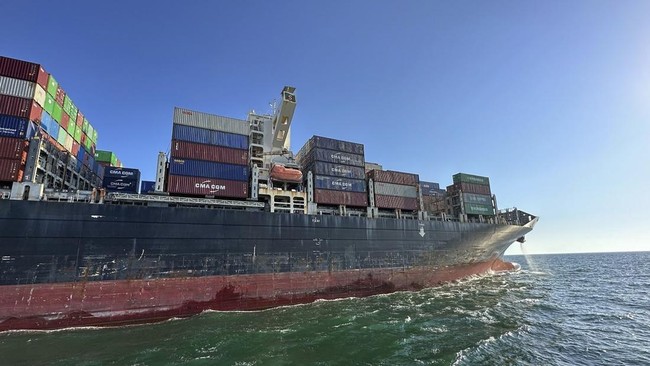
A detailed investigation released by CNN has revealed a major mystery behind the sinking of the Russian cargo ship Ursa Major off the coast of Spain. The vessel is strongly suspected of transporting two submarine nuclear reactors destined for North Korea before it exploded and sank under highly questionable circumstances.
Citing CNN International on Tuesday (12/05/2026), the Ursa Major sank on 23 December 2024, approximately 60 miles from the coast of Cartagena, Spain. The investigation indicates the possibility of Western military intervention to prevent Russia from sending advanced nuclear technology to its key ally, Kim Jong Un, just two months after North Korea sent troops to assist Moscow’s invasion of Ukraine.
The Spanish government finally spoke out on 23 February following pressure from the opposition. According to official statements, the Russian captain admitted to investigators that the Ursa Major was carrying components for two nuclear reactors similar to those used in submarines, although he claimed uncertainty about whether the reactors contained nuclear fuel.
“The captain eventually admitted that the items initially described as ‘manhole covers’ were actually components from two nuclear reactors similar to those used in submarines,” read the Spanish government’s statement to parliament.
The mystery deepened with unusual military activity around the wreck site. US nuclear “sniffer” aircraft were reported to have flown over the sinking location twice in the past year. Additionally, a Russian spy ship was detected visiting the site a week after the incident, triggering four additional underwater explosions.
The investigation by Spanish maritime authorities in Cartagena suggests the possible use of a rare “Barracuda” torpedo to breach the hull. This high-speed supercavitating torpedo can penetrate metal without a large explosion sound, matching the findings of a 50 cm by 50 cm hole in the hull that was bent inwards.
“The use of such a device would match the size of the hole in the Ursa Major’s hull and could cause an impact without sound, leading to the ship suddenly slowing down,” revealed a source familiar with the Spanish investigation results.
The timeline shows that on the night before the sinking, the Russian warship Ivan Gren, escorting the Ursa Major, ordered Spanish rescue vessels to stay two nautical miles away. Shortly afterwards, the Ivan Gren fired a red signal followed by four underwater explosions whose vibrations were recorded by Spain’s National Seismic Network.
The captain, identified as Igor Anisimov, is believed to have feared for his safety during interrogation by Spanish police. Investigation sources mentioned that Anisimov believed his ship was to be diverted to the port of Rason in North Korea to deliver the reactors, strengthening suspicions of a nuclear technology barter between Moscow and Pyongyang.
Senior naval platform analyst from Janes, Mike Plunkett, assessed that if Russia is indeed transferring this technology to North Korea, it represents a highly serious and concerning step for regional stability, especially for South Korea.
“Russia’s decision to transfer this technology is not taken lightly and is only done between very close allies. If true, this is a major step from Moscow,” stated Plunkett.
To date, the wreck of the Ursa Major lies at a depth of 2,500 metres below the Mediterranean Sea surface. The US and Russian governments have refused to provide official comments on the incident, while the secrets of what truly happened and what was inside the ship are buried with the debris on the seabed.