
Russian Drone Strike Hits Train Near Polish Border Following Visit by Boris Johnson
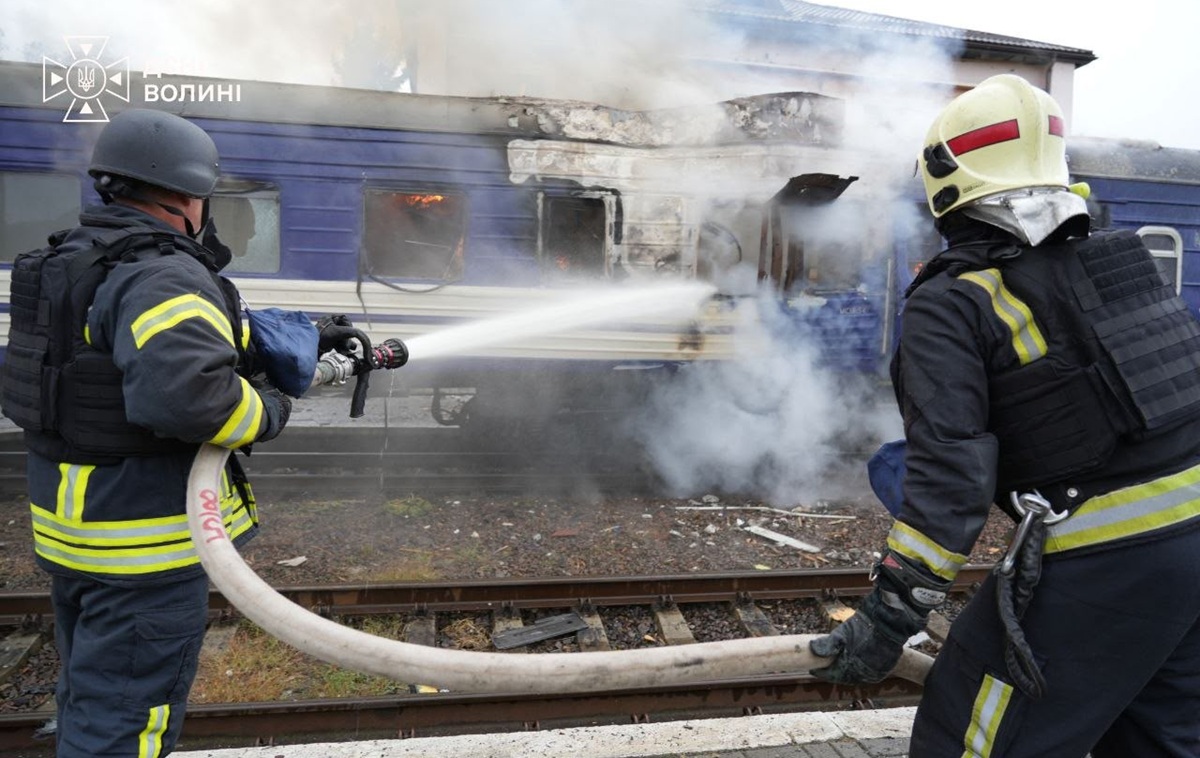
Passengers were jolted awake by the sound of commotion. A Russian jet drone struck a train locomotive in Yahodyn, in the Ukraine-Poland border region, shortly after former British Prime Minister Boris Johnson and several high-ranking European security officials had passed through the route.
Ukrainian authorities confirmed there were no fatalities in the incident, as all passengers had been evacuated approximately 15 minutes before the strike occurred. Boris Johnson, accompanied by European national security advisers including the UK’s Jonathan Powell, was known to be travelling on a different train during the return journey following his attendance at the Yalta European Strategy (YES) conference in Kyiv.
Russia claimed the attack targeted railway infrastructure in western Ukraine. However, the Ukrainian state railway company, Ukrzaliznytsia, indicated that the drone’s target was likely a diplomatic train. “The train departed from the station earlier than scheduled due to changes necessitated by the ongoing threat of Russian attacks,” Ukrzaliznytsia stated in an official communiqué.
In addition to Johnson, Ukrainian railway authorities revealed that former CIA Director David Petraeus was also on another train at Yahodyn Station when the attack occurred. Ukrainian and Polish authorities confirmed the explosion site was only 2 kilometres from the Polish border.
Former Swedish Prime Minister Carl Bildt, who also attended the conference in Kyiv, described his experience when his train came to an abrupt halt. “On the train I was travelling on, we received orders to prepare for evacuation after the train stopped. However, a few minutes later, we were told the situation was safe and the journey could continue,” said Bildly. The train eventually arrived safely at Dorohusk Station in Poland.
Responding to the event, Boris Johnson condemned Moscow’s actions, describing them as irrational. “I do not know what twisted logic drives Putin to blow up a Ukrainian locomotive stopped at the Polish border this morning,” Johnson wrote on the social media platform X. “This is a form of random and senseless attack that Ukrainian citizens must face every day—even on civilian railway lines,” he continued, while urging Kyiv’s allies to immediately distribute the necessary air defence systems to Ukraine.
Ukrainian Foreign Minister Andrii Sybiha described the attack in Yahodyn as a form of terror creeping closer to EU and NATO territories. “Putin needs to understand that his barbarity will be met with decisive action that increases the cost of war for him to an unacceptable level. This is the only way to stop it,” Sybiha asserted.
The impact of this escalation has triggered security concerns in neighbouring nations. Polish Prime Minister Donald Tusk immediately convened an emergency meeting to respond to the intensifying situation. “The escalation of Russian actions is becoming a reality, and they are moving closer to our borders,” said Tusk.
This attack extends the grim record of Russian military targeting public transport facilities. The railway network has been a vital mode of transport for millions of Ukrainians since all civilian flights were suspended following the full-scale invasion in 2022.
Earlier this week, Russian drone strikes on the Ukraine-Moldova border killed two people. A separate attack on a passenger train in southern Ukraine also killed a female conductor, and six Ukrzaliznytsia employees were killed by the bombing of a depot in Kyiv earlier this month. In January, President Volodymyr Zelensky condemned a Russian attack on a passenger train in Kharkiv, which killed five people, as an act of terrorism.
Beyond the combat zones, several European nations have accused Russia of being behind various acts of sabotage. Germany accused Russia of being responsible for a drone attack at Leipzig Airport last August, a claim Moscow dismissed as absurd. A number of suspicious fires in defence facilities ranging from Italy to Estonia are also suspected of involving Russian involvement.