
Russian Allies 'Fractured' as Armenia Rejects Putin's Demands
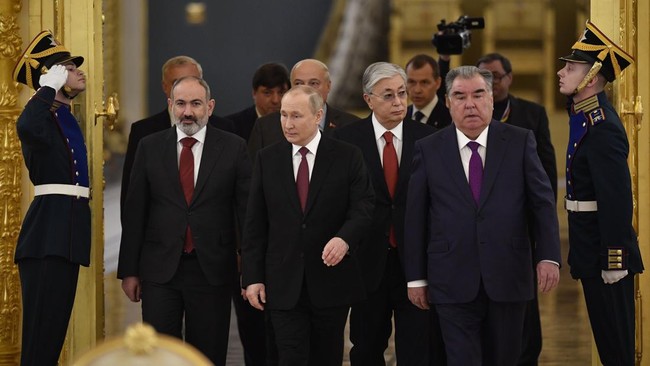
Relations between Russia and Armenia have entered a period of heightened tension following the Armenian Prime Minister’s refusal to heed Moscow’s push for an immediate referendum regarding the country’s membership in the European Union (EU). This rejection occurs amidst escalating political and economic pressure from the Kremlin against its traditional ally, as Armenia increasingly moves closer to the West.
According to Al Jazeera, Prime Minister Nikol Pashymyan openly rejected the call supported by Russian President Vladimir Putin for Armenia to decide between remaining within the Russian-led economic bloc or joining the EU. The refusal was stated on Monday, coinciding with a telephone conversation between Putin and Pashinyan during which the Russian leader offered birthday congratulations to the Armenian leader.
The recent dispute between the two nations began following the Eurasian Economic Union (EAEU) summit in Kazakhstan on 29 May. During that meeting, Putin, alongside the leaders of Belarus, Kazakhstan, and Kyrgyzstan, issued a joint statement urging Armenia to hold a referendum regarding its plans to join the EU.
From Russia’s perspective, it is impossible for Armenia to be an EU member while remaining within the EAEU. Putin also issued a warning that many interpreted as a veiled threat against Armenia’s Western ambitions, reminding the Prime Minister that the ‘Ukraine scenario’ began with Kyiv’s aspirations to join the EU. This statement was made against the backdrop of deteriorating Russian-Western relations and the ongoing war in Ukraine.
Responding to the pressure, Pashinyan asserted that the Armenian government sees no reason to hold a referendum in the near future. In a video speech broadcast on social media, he stated that the government in Yerevan will continue to operate within the EAEU until a choice between the two blocs becomes truly unavoidable. He also noted that a referendum at this stage is purely theoretical, as Armenia has not yet applied for official EU candidate status. “Subjecting a theoretical choice to a referendum is certainly not very sensible or justifiable,” Pashinyan said.
He described the current relationship between Armenia and Russia as being in a “transformation phase.” Both the Kremlin and the Armenian government stated that the telephone conversation between Putin and Pashinyan addressed the outcomes of the EAEU summit and the Russian leader’s birthday wishes.
This political tension is developing ahead of Armenia’s parliamentary elections scheduled for 7 June. In recent days, Russia has increased pressure on Armenia through various diplomatic and economic measures. Last weekend, Moscow recalled its ambassador to Armenia for consultations. Furthermore, on Monday, Russian agricultural supervisory authorities suspended imports of fish and seafood from Armenia, citing violations of health standards.
This policy has significant implications, as Armenia’s fisheries sector exports approximately 30% of its products to the Russian market. The ban follows previous trade restrictions on various Armenian products, including agricultural goods, flowers, mineral water, and alcoholic beverages. Such measures are known as economic pressure instruments frequently used by Moscow against former Soviet territories that pursue policies out of alignment with the Kremlin.
The EU has also reacted to Russia’s actions. On Monday, the bloc accused Moscow of attempting to cripple Armenia’s economy to influence the upcoming election results. This accusation adds a new dimension to the competition for influence between Russia and Europe in the South Caucasus region.
Armenia has been known as a close Russian ally for decades. However, Yerevan’s foreign policy direction began to shift following the conflict with Azerbaijan over the Nagorno-Karabakh region. This shift in orientation became more evident after the 2023 conflict, during which Azerbaijan launched a military offensive in Nagorno-Karabakh, resulting in Armenia losing control of the territory that had been a source of dispute for decades.
Many in Armenia believe that Russia failed to provide the expected support to its ally during the crisis. This disappointment has driven Yerevan to diversify its international relations. This process has accelerated since Russia’s full-scale invasion of Ukraine in February 2022. In recent months, Armenia has significantly deepened its ties with Europe. Last month, the country hosted its first official summit with the EU, a regional meeting also attended by Ukrainian President Volodymyr Zelenskyy. Armenia also received a state visit from French President Emmanuel Macron, which garnered widespread attention.
Source: jawawa.id (https://jawawa.id/newsitem/russian-allies-fractured-as-armenia-rejects-putins-demands-1780864624)
Originally published by CNBC Indonesia (https://www.cnbcindonesia.com/news/20260602150419-4-739464/sekutu-rusia-pecah-negara-ini-tolak-permintaan-putin), translated from Indonesian