
Russia Serious About Developing Space City in Biak, Ready to Build Satellite Launch Infrastructure
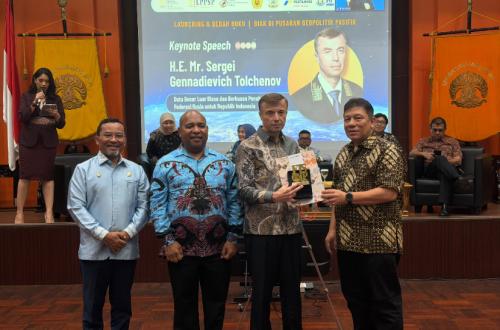
DEPOK — Russia has said it is ready to take part in developing space infrastructure in Biak, Papua. Moscow says it is prepared to contribute once Indonesia makes a final decision to begin building facilities in the area.
The commitment was conveyed by Russia’s Ambassador to Indonesia, Sergei Gennadievich Tolchenov, at the launch and discussion of Biak at the Centre of Pacific Geopolitics: Russia, Satellites and Indonesia’s Strategic Future, by Laus D.C. Romayom. The event was held at the Juwono Sudarsono Auditorium, Faculty of Social and Political Sciences, University of Indonesia (UI), in Depok on Thursday (5 November 2026).
Tolchenov said Biak’s strategic geographical position was one of its main attractions for space infrastructure development. The Russian Embassy, he said, was ready to facilitate cooperation between Russia’s space agency and Indonesia’s National Research and Innovation Agency (BRIN).
The remarks signal Russia’s seriousness in exploring space cooperation with Indonesia, particularly the development of satellite-launch facilities in Biak. Tolchenov reiterated that Russia was ready to contribute if the Indonesian government made a final decision to proceed with construction.
The book launch was organised by the Centre for International Relations Studies at the Faculty of Social and Political Sciences’ Institute for Social and Political Research and Development (CIReS LPPSP FISIP UI). The forum brought together diplomatic representatives, ministries and agencies, local government, academics, civil society and students to discuss Biak’s strategic position in Pacific geopolitics.
CIReS LPPSP FISIP UI director Prof. Dr Fredy BL. Tobing said the book was intended to introduce Biak’s strategic potential and reflect the University of Indonesia’s interest in Papua’s development. He said he hoped the discussion would encourage the development of eastern Indonesia.
Biak Numfor Deputy Regent Jimmy Carter Rumbarar Kapissa, who attended on behalf of the regent, welcomed the publication. He said Biak had considerable potential as a strategic area, spanning space geopolitics, energy and food security, and its role as a maritime hub and logistics centre.
“Biak is no longer merely Indonesia’s backyard. It has its own value as a potential hub for the world’s maritime routes,” Jimmy said.
He hoped the book would serve as a reference for policymakers in setting the direction of Biak’s future development.
Space geopolitical competition
Book author Laus D.C. Romayom said the idea for the publication stemmed from concern that Biak’s strategic position had not been fully utilised.
He said Biak’s strategic value rested on four aspects: its geographical position, access, infrastructure and regional function. Russia’s interest, including in developing an air-based satellite-launch system, showed that interest in Biak had moved beyond the question of local development.
However, he cautioned that developing a space region would require infrastructure investment, improvements in human resources and institutional continuity. Development must also respect the rights of Indigenous communities.
“Biak is not only about what the world wants from Indonesia, but also about what Indonesia wants and is able to do for its own future in the Pacific,” Laus said.
He stressed that the success of Biak’s development should not be measured solely by whether international cooperation was established. The project should also strengthen national technological capacity and improve the welfare of Papua’s people.
During the book discussion, moderated by documentary journalist Tiara Harahap of INADIS Horizon, academics and stakeholders shared views on the opportunities and challenges of developing a space region in Biak.
Prof. Dr Erna Sri Adiningsih of the BRIN Indonesia Space Agency (INASA) highlighted the challenge of coordinating Indonesia’s various space institutions. She also pointed to the potential of a space economy that could create opportunities for private-sector participation.
She said Biak should become a key asset in Indonesia’s space diplomacy.
Meanwhile, Lab45 researcher Dr Andi Widjajanto warned that building space facilities in Biak would bring Indonesia into an increasingly complex international system.
Indonesia therefore needed to uphold its bebas aktif, or independent and active, foreign policy in choosing cooperation partners, he said. Space technology development could not be separated from the dynamics of global geopolitical competition.
Broto Wardoyo of the UI Faculty of Social and Political Sciences’ International Relations Department said the book opened up broader research opportunities on Papua, particularly Biak’s position amid global competition in technology and space.
Asra Virgianita, PhD, also from the department, emphasised the importance of political economy and environmental perspectives. She said cooperation on the space economy should be built on equal terms and should not draw Indonesia into global political rivalries.
Indigenous communities must be involved
Papua electoral district DPD RI member Filep Wamafma said the people of Biak must be central to plans to develop the space region.
He said Biak’s residents had the necessary human-resource capacity, but the government and BRIN needed to explain transparently how the project would benefit local communities and regional government.
Environmental safeguards and the protection of residents’ livelihoods also needed to be prioritised.
“The people of Biak understand Biak itself far better. If tensions arise, make room for Biak’s intellectuals to speak,” Filep said.
During the question-and-answer session, participants from ministries, the UI Faculty of Law and the International Relations programme at the Indonesian Christian University raised questions about job opportunities for Indigenous Papuans, the certainty of customary land rights and fair mechanisms for sharing economic benefits.
Participants also pointed to opposition to the development plans among some church figures and community members.
In response, Erna emphasised the need for sustained capacity-building programmes and affirmative education policies for local people. Filep said the DPD RI was open to dialogue to hear community aspirations.
Asra said assessments of economic benefits needed to go hand in hand with environmental impact analysis and the protection of Indigenous communities.
Through the forum, CIReS LPPSP FISIP UI said it hoped Biak would be understood not merely as a potential site for space facilities, but also as a strategic area shaping Indonesia’s position in the Pacific.
Ultimately, development in Biak must put national interests and the people of Papua first, amid growing attention from major powers to the space sector.
Source: jawawa.id (https://jawawa.id/newsitem/russia-serious-about-developing-space-city-in-biak-ready-to-build-satellite-launch-infrastructure-1793875894)
Originally published by Republika (https://news.republika.co.id/berita/to0ykz393/rusia-serius-garap-kota-antariksa-di-biak-siap-bangun-infrastruktur-peluncuran-satelit), translated from Indonesian