
Russia Prepares Su-57D as the Brain of AI-Based Drone Swarms
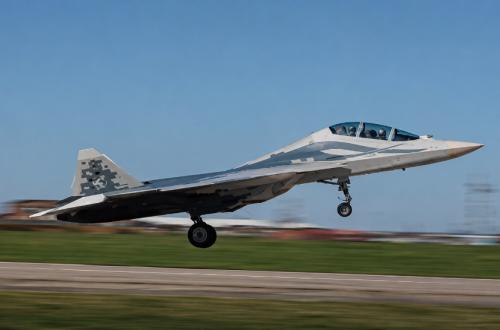
The future of Russian air combat appears no longer to be imagined as a duel between one fighter aircraft and another. Moscow is beginning to prepare a scenario in which a manned aircraft becomes the command centre for a number of unmanned machines moving alongside it.
At the centre of this experiment is the Su-57D, a two-seat variant of the Su-57 fighter that Russia classifies as a fifth-generation jet. Sukhoi Design Bureau director Mikhail Strelets revealed that the aircraft’s second seat opens the way for the application of one of the technologies Russia associates with sixth-generation combat aviation: controlling unmanned aircraft from an airborne command post.
Strelets’ statement, reported on 14 August 2026, makes the Su-57D’s function appear far more ambitious than merely a two-seat trainer aircraft. One crew member can concentrate on flying and primary combat duties, while an operator in the other cockpit handles the unmanned systems operating alongside the aircraft.
Interestingly, Sukhoi is not only talking about controlling a single drone. Strelets said the two-seat configuration is important for controlling “intelligent complexes” as well as unmanned systems in groups or swarms. He also revealed that one function of the new Su-57 variant is to serve as a testbed for the combat artificial intelligence currently being developed by the design bureau.
In other words, Russia is attempting to turn the second cockpit into a battle management space.
The pilot does not have to shoulder the entire burden of flying the jet, facing opponents, operating weapons, reading sensors, and simultaneously controlling a number of drones. Some of that work can be transferred to the second operator and, at a later stage, assisted by autonomous systems and artificial intelligence. But there is an important limit that must be underlined.
Sukhoi has not yet announced that the AI-based drone swarm has become an operational capability of the Su-57D. Strelets’ statement speaks about the direction of development, the capability to be realised, and the testing of combat artificial intelligence.
Thus, the Su-57D is currently more accurately viewed as Russia’s bridge towards the next-generation air warfare concept rather than as an “AI swarm commander” whose full capabilities are already ready for use.
Maiden Flight in May
The Su-57D is no longer merely a design drawing. The two-seat aircraft prototype made its maiden flight on 19 May 2026. United Aircraft Corporation, or UAC, part of the state-owned company Rostec, stated that the flight was carried out by Sukhoi chief test pilot Sergey Bogdan.
When announcing the maiden flight, Russian officials had already provided hints about the function to be built. Russian First Deputy Prime Minister Denis Manturov said the variant has a function as a combat trainer aircraft as well as a command and control aircraft.
The concept of command over unmanned systems then became increasingly clear through Strelets’ explanation in August. This is what distinguishes the Su-57D from the simple logic of a two-seat trainer aircraft. The additional seat is not only intended so that an instructor can accompany another pilot, but also opens space for an operator to handle the complexity of combat involving unmanned platforms.
Source: jawawa.id (https://jawawa.id/newsitem/russia-prepares-su-57d-as-the-brain-of-ai-based-drone-swarms-1787021530)
Originally published by Republika (https://news.republika.co.id/berita/tjxunk451/rusia-siapkan-su57d-jadi-otak-kawanan-drone-berbasis-ai), translated from Indonesian