
Ruskandar's Bioflok Fish Farming Business Supports Retirement Income with BRI Assistance
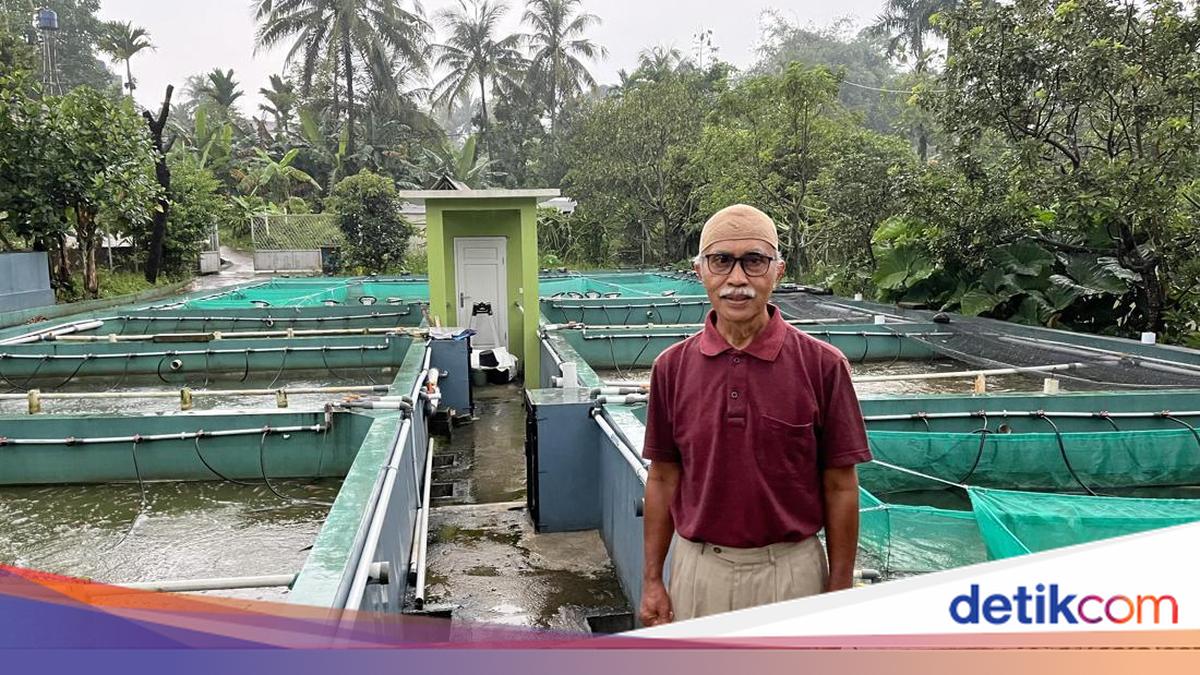
The sound of light rain meets the hiss of air bubbles from Ruskandar’s bioflok pond in Purwasari Village, Dramaga District, Bogor Regency. Tiny bubbles emerge from a constant-running aerator supplying oxygen to thousands of tilapia in the tank.
On a gloomy afternoon, the 63-year-old Ruskandar showed visitors around his eight bioflok fish ponds, eagerly explaining his retirement business.
Ruskandar, a retired employee of a state-owned enterprise (BUMN), spent decades in corporate life before turning his front yard into a fish farm to supplement his family’s income.
He started conventional fish farming in 2019, but yields were suboptimal. Low production and water scarcity prompted him to seek alternative methods.
In 2025, he switched to bioflok – an environmental engineering technique relying on oxygen supply and microorganisms. He learned about the method online and from friends at Bogor Agricultural Institute (IPB).
‘Conventional systems hold 25 fish per cubic metre, but bioflok can manage 150 to 200 per cubic metre, provided parameters like oxygen, pH, temperature, ammonia, and nitrate levels are properly maintained,’ Ruskandar said on Thursday, 14 May 2026.
He now manages eight ponds: six for growing, one for spawning, and one for ready-to-harvest fish. Each 20-square-metre pond holds 2,500 to 3,000 fish.
‘I use a high-density stocking system,’ Ruskandar said.
The shift to bioflok wasn’t smooth. Initially, he struggled to source fish fry due to distant suppliers, leading to high mortality rates.
‘Poor handling meant out of 8,000 fry purchased, only 1,250 survived,’ he said.
From this, he learned better handling techniques to safely raise fry in his home pond.
Fry grow for about four months before reaching harvest size.
Each pond yields 600kg. Total production across all grow-out ponds exceeds three tonnes.
‘I hope the market remains strong,’ Ruskandar said.
Sales are currently direct from home, not online. Buyers include retailers, restaurant owners, and cooperative managers from Bogor, Jakarta, and Tangerang.
Prices vary; buyers in Bogor get lower rates than those elsewhere.
‘Jakarta buyers only bring cash – no oxygen, plastic, or equipment – so we handle everything,’ he added.
The business stabilised in early 2026. Customers praise bioflok fish for being less muddy-tasting, tastier, and with firmer flesh compared to conventionally farmed fish.
‘Thankfully, customers say bioflok fish has no muddy smell, better taste, and thicker flesh,’ he said.
Each harvest brings around Rp 2 million per pond, totalling Rp 12 million across all ponds. He also hires temporary staff for harvesting, maintenance, and sorting.
‘Only when needed – during harvest, maintenance, or sorting – not daily,’ Ruskandar said.
The business supports his family’s needs in retirement. ‘Expenses continue even after retiring, so this income is vital,’ he added.
The local community also benefits, buying cheaper fish than market prices.
‘Thankfully, especially traders and rice sellers – they no longer need to travel far to the market; they can order directly,’ Ruskandar said.
Ruskandar secured a Rp 15 million loan via BRI’s Kupedes rural credit programme, which boosted production.
‘Thankfully, it helped resolve issues,’ Ruskandar said.
He thanked BRI for the timely support. The loan application was swiftly processed.
‘I’m grateful BRI responded quickly – within days – surveyed, and disbursed funds shortly after,’ he said.
Jexon Markus, Head of BRI Sindang Barang Unit, praised Ruskandar’s shift from conventional to bioflok farming. ‘The technology is perfectly suited to his needs,’ he said.
‘Its application is highly effective, aiding customers in managing their businesses,’ Jexon added.
Source: jawawa.id (https://jawawa.id/newsitem/ruskandars-bioflok-fish-farming-business-supports-retirement-income-with-bri-assistance-1779897634)
Originally published by detikcom (https://news.detik.com/berita/d-8507710/cerita-ruskandar-dibantu-bri-usaha-ikan-bioflok-topang-ekonomi-di-masa-pensiun), translated from Indonesian