
RUPTL’s 100 GWp Solar Power Target Opens Investment Opportunities for China
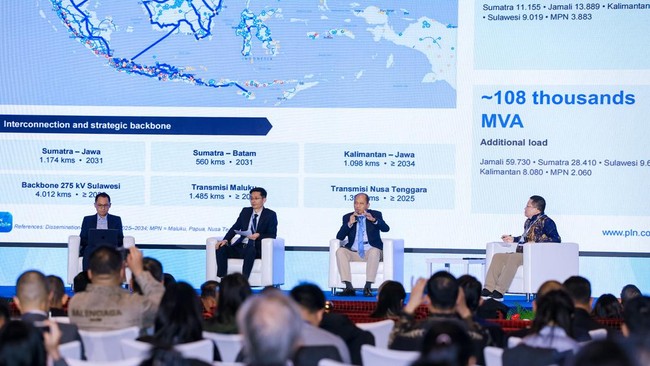
Jakarta, CNBC Indonesia — Indonesia’s plan to build more renewable power plants, particularly solar power plants (PLTS) with a capacity of 100 gigawatt-peak (GWp), is opening investment opportunities for Chinese companies in the electricity sector. As solar capacity grows, Indonesia will need investment in transmission networks to carry electricity from generating sites to centres of demand.
Battery-based storage systems will also be needed so that electricity generated during the day can be used when solar output declines. These opportunities were discussed at the China RE Invest Indonesia 2026 forum in Beijing on 2 November. The Embassy of the Republic of Indonesia in Beijing, Tenggara Strategics and CSIS Indonesia held the forum to bring together government representatives and industry players from both countries.
During business-matching sessions, representatives of state electricity company PT PLN met in person with Chinese investors and financing institutions to discuss potential partnerships.
Parulian Noviandri, PLN’s Executive Vice-President for Strategic Generation Planning, outlined Indonesia’s electricity investment needs through to 2034. The 2025–2034 Electricity Supply Business Plan (RUPTL) requires Rp2,967 trillion in investment and targets an additional 69.5 gigawatts (GW) of capacity.
About 76% of that additional capacity will come from renewable energy and energy storage systems. In the generation sector, around 73% of investment is open to private power producers (independent power producers/IPP). Outside the RUPTL, the 100 GWp solar programme further expands investment opportunities in the sector.
Parulian said the programme comprises about 89.1 GWp of solar capacity connected to PLN’s grid and 11.7 GWp outside it. Taking investment readiness, regulation and supporting infrastructure into account, PLN has identified around 35 GWp of potential capacity for development by 2029.
“Overall, the programme is estimated to require Rp1,140 trillion in investment and could create around 2.8 million jobs during construction,” he said, as quoted on Saturday (14 November 2026).
He said the scale of infrastructure needs was evident in PLN’s plan under the 2025–2034 RUPTL to build nearly 48,000 kilometres of additional transmission lines and new substations with a capacity of around 108,000 megavolt-amperes (MVA). The network will help connect renewable energy generation sites with areas requiring additional electricity supplies.
“The scale of generation and network development creates room for Chinese companies with experience in building utility-scale solar plants, manufacturing solar panels and batteries, and financing renewable energy projects. For prospective investors, project location is one consideration because it affects the incentives available,” he said.
Rizaldi Indra Janu, director of the Indonesia Investment Promotion Center (IIPC) in Beijing, said eligible investments in special economic zones (KEK) could receive corporate income tax exemptions, or tax holidays. He also highlighted the growing domestic market and investment opportunities in related industries, including green manufacturing and electric vehicle supply chains.
In addition to incentives, prospective investors need to factor in foreign-exchange risks, particularly for projects with large upfront costs and long-term financing. Yulian Wihantoro, head of Bank Indonesia’s representative office in Beijing, said hedging instruments offered by financial institutions could help investors manage these risks.
He also saw opportunities to use the Local Currency Transaction (LCT) framework between Indonesia and China to support bilateral investment.
After assessing project costs and financing, investors also need to understand land procurement processes and employment regulations in Indonesia. Humphrey R. Djemat, head of the law firm Gani Djemat and Partners, advised Chinese companies to engage legal and business advisers from the outset to assess investment feasibility and anticipate potential disputes and operational challenges.
On the Chinese company side, Zhou Kai, general manager of the Market Management and Investment Department for Southeast Asia at China Energy International Group, saw opportunities for co-operation ranging from electricity system planning to project construction and financing. He highlighted the development of solar and wind power plants, energy storage, inter-island transmission and grid modernisation.
Zhou also noted that fragmented electricity networks, provisions in power purchase agreements and foreign-exchange risks were considerations for investors.
In the coming years, one measure of progress on the 100 GWp solar programme will be how much of the 35 GWp of potential capacity mapped by PLN reaches the construction stage by 2029. For projects supplying electricity to PLN’s grid, land and financing readiness will need to be matched by grid readiness at each project site so that power can be transmitted when plants begin operating.
Source: jawawa.id (https://jawawa.id/newsitem/ruptls-100-gwp-solar-power-target-opens-investment-opportunities-for-china-1794639031)
Originally published by CNBC Indonesia (https://www.cnbcindonesia.com/news/20261114130542-4-785227/target-plts-100-gwp-ruptl-buka-peluang-investasi-china), translated from Indonesian