
Rupiah’s Record Low Is Not Due to Gibran’s Resignation—Here’s What Is Driving It
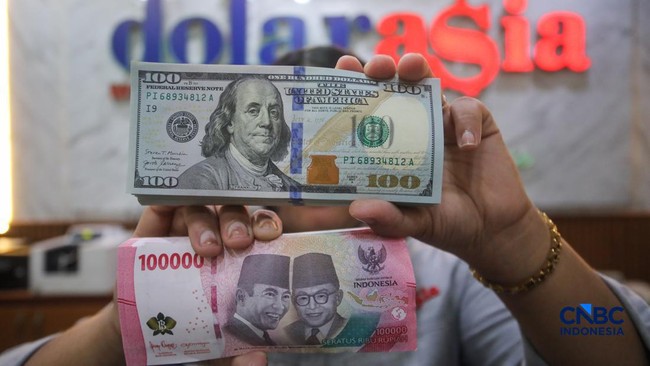
Jakarta, CNBC Indonesia — Vice-President Gibran Rakabuming Raka officially submitted his resignation to the People’s Consultative Assembly (MPR) this morning (12 November 2026). At the same time, the rupiah was trading at Rp18,252 per US dollar at 1pm Western Indonesia Time, its lowest level on record.
Dipo Satria Ramli, an economist at the Center of Reform on Economics (CORE) Indonesia, said the rupiah’s weakness was driven more by uncertainty following the Vice-President’s resignation.
Market participants, he said, had anticipated Gibran’s departure. The vacancy in the vice-presidential office, however, could be a greater negative factor for the capital market and the rupiah.
“On Gibran’s resignation, we could argue that economic actors or the market may have anticipated it. But what they may not have anticipated is, for example, if Gibran resigns, who will replace him? That will be the bigger question,” he told CNBC Indonesia on Wednesday (12 November 2026).
“That question will create uncertainty, and that uncertainty will shake the market,” he added.
Dipo said investors would watch how Bank Indonesia (BI) acted to maintain exchange-rate stability while market uncertainty persisted and they waited for Gibran’s replacement.
He said the central bank had many tools at its disposal to contain pressure on the rupiah, and that the key issue was how effectively BI could use them.
“The rupiah may depend on what BI does as well. BI has several tools for market intervention, so it depends on how strongly it can hold back the [currency’s] decline,” Dipo said.
Meanwhile, M Rizal Taufikurahman, head of macroeconomics at the Institute for Development of Economics and Finance (Indef), said the rupiah’s weakness could not be separated from external pressures, although domestic political turmoil could make matters worse.
Rizal said the turmoil—particularly reports of the Indonesian President being wiretapped and the Vice-President’s resignation—was not the sole cause of the rupiah’s depreciation. It could, however, raise perceptions of risk if it created political and policy uncertainty.
“Amid pressure from the US dollar and foreign capital flows, political instability adds to the rupiah’s vulnerability,” he told CNBC Indonesia on Wednesday (12 November 2026).
He explained that markets responded not only to political events, but also assessed the government’s ability to maintain stability and the credibility of its policies.
If conflict among political elites continued for an extended period, Rizal said, the risk of capital outflows would rise, putting further pressure on the rupiah and potentially pushing up yields on government securities (SBN).
“This means political uncertainty can increase economic costs even before it directly affects real-sector activity,” he said.
In his view, the government must not allow political turmoil to become an additional source of economic uncertainty. Constitutional certainty, policy consistency and fiscal-monetary coordination must be strengthened.
Bank Indonesia, meanwhile, cannot remain the sole bulwark for rupiah stability through market intervention.
“Exchange-rate stability requires government credibility, not just foreign-exchange reserves and monetary instruments,” he added.
Source: jawawa.id (https://jawawa.id/newsitem/rupiahs-record-low-is-not-due-to-gibrans-resignation-heres-what-is-driving-it-1794473534)
Originally published by CNBC Indonesia (https://www.cnbcindonesia.com/news/20261112140700-4-784659/rupiah-anjlok-bukan-karena-wapres-gibran-mundur-ini-masalahnya), translated from Indonesian