
Rupiah Worst Performer in Asia as Won, Yen, and Ringgit Strengthen
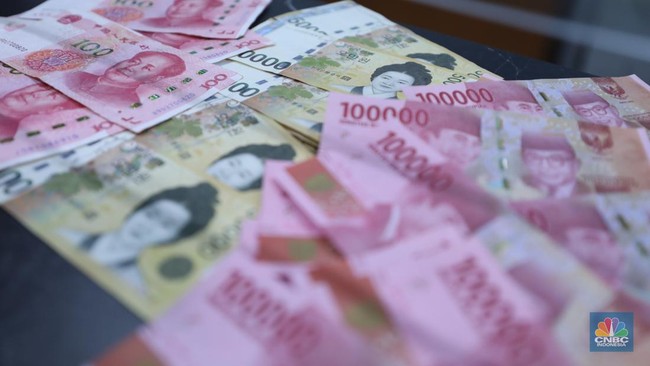
Currencies of Asian countries mostly strengthened against the US dollar on Monday morning. Unfortunately, the rupiah recorded the deepest depreciation.
According to Refinitiv data, in Monday’s trading (20/7/2026), as of 09:15 WIB, of the 10 Asian currencies tracked, six strengthened against the US dollar while the other four weakened.
The rupiah came under the greatest pressure in Asia this morning. The Garuda currency weakened 0.59% to Rp17,990/US, apositionthatbringstherupiahonceagainveryclosetothepsychologicallevelofRp18, 000/US.
Besides the rupiah, the Philippine peso also entered the red zone after weakening 0.24% to PHP 61.694/US.TheThaibahtwasdown0.12, while the Taiwan dollar slipped 0.03% to TWD 32.382/US$.
On the other side, the South Korean won was Asia’s sharpest gainer, strengthening 0.38% to KRW 1,481.9/US$.
Gains were also seen in the Vietnamese dong and the Malaysian ringgit, both rising 0.12%. The ringgit stood at MYR 4.085/US$.
The Chinese yuan strengthened 0.06% to CNY 6.771/US, whiletheJapaneseyenandtheSingaporedollarbothrose0.04 and SGD 1.2907/US$ respectively.
Meanwhile, the US dollar index (DXY) was stable at 100.765 at the same time. Although it has moved little this morning, the US dollar continues to receive support from global sentiment that has not yet fully calmed.
The US dollar strengthened slightly against the majority of global currencies at the start of Asian trading. This came after the conflict in the Middle East escalated once again, oil prices rose, and investor confidence remained fragile following pressure on markets last week.
Westpac analysts judged the foreign exchange market to be relatively calm, but the US dollar remains steady amid deteriorating risk sentiment.
“The FX market is relatively calm, with the US dollar broadly stable, while the Australian dollar weakened against the greenback and most major currencies,” Westpac analysts wrote in their research, quoted by Reuters.
Westpac also highlighted pressure from technology stocks, particularly regarding semiconductor valuations, which weighed on investor appetite for riskier assets.
“Market sentiment continues to deteriorate as concerns over semiconductor valuations suppress risk appetite, while tensions in the Middle East escalate after Iran suspended its commitments under the temporary peace agreement,” Westpac wrote.
Rising oil prices also drew market attention. Brent oil prices surged 3.3% to US$90.97 per barrel at the start of Asian trading. The increase came after the United States announced on Sunday that it had launched its ninth consecutive night of attacks on Iran, having previously announced that at least two US military personnel had been killed in Jordan.
The renewed rise in oil prices has reignited inflation concerns. If energy pressure persists, markets will once again scrutinise the scope for global central banks, including the US central bank (the Federal Reserve/The Fed), to maintain tighter policy for longer.
Even so, markets still expect The Fed to hold interest rates at its next meeting on 29 July. Based on CME FedWatch, fed funds futures are pricing in an 85.6% probability that The Fed will keep rates unchanged, up from 61.5% a month earlier.
However, the debate within The Fed has not fully subsided. Cleveland Fed President Beth Hammack on Friday echoed the view that interest rates may need to rise to curb still-persistent inflation. That view could make The Fed’s next meeting more heated, particularly at what will be the second meeting for Kevin Warsh as Fed Chair.