
Rupiah Weakness Sparks Concern Among Indonesian Entrepreneurs Over Next Six Months
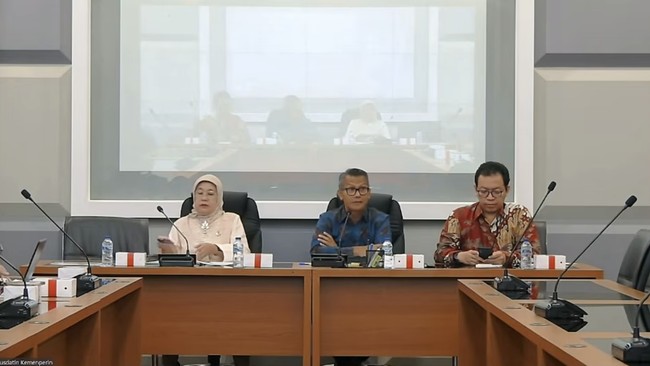
Jakarta, CNBC Indonesia – The Ministry of Industry (Kemenperin) reports that national industrial confidence remains strong despite global uncertainties and the rupiah’s depreciation. However, entrepreneurs are concerned about the next six months due to the current currency weakness.
On Tuesday, 26 May 2026, ahead of the Eid al-Adha long holiday, the rupiah closed significantly weaker against the US dollar. Throughout trading, the currency faced pressure, opening flat at Rp17,730/US$ before weakening to a low of Rp17,790/US$.
According to Refinitiv data, the rupiah ended trading at Rp17,775/US, a0.25.
Ministry of Industry spokesperson Febri Hendri Antoni Arief noted this was reflected in a surge of the May 2026 Industrial Confidence Index (IKI) to 53.56. As the index remains above 50, it indicates continued expansion.
The May 2026 IKI rose 1.81 points from April 2026’s 51.75 and 1.45 points from May 2025’s 52.11.
“The significant rise in the IKI reflects industry optimism regarding President Prabowo’s decision not to raise subsidized fuel prices,” he said during the May 2026 IKI press conference, broadcast on the Ministry of Industry’s official YouTube channel on Tuesday (26/5/2026).
“This policy has kept inflation under control, boosting consumer purchasing power for manufactured goods. We know 80% of manufacturing output serves domestic demand, with the remaining 20% for exports,” he added.
Business optimism, Febri said, saw overall business activity improve in May 2026.
“Business conditions in May 2026 improved compared to the previous month, with 75.6% of respondents reporting their operations as either improving or stable,” he stated.
Of these, 34.2% of industries reported improving conditions in May 2026, a 3.4% increase from the previous month. Meanwhile, 41.4% reported stable conditions, a 0.3% decrease.
“The percentage of businesses reporting declining conditions fell by 3.2% to 24.4%,” he added.
However, the Ministry noted a slowdown in business optimism for the next six months.
The optimism level for business conditions over the next six months in May 2026 decreased compared to recent months, standing at 69.9%.
“This represents a 0.2% slowdown from the previous month,” he said.
22.7% of businesses expect stable conditions over the next six months, down 0.8% from the previous month.
“Pessimism among businesses regarding the next six months rose 1.0% to 7.4%,” Febri added.
“This is due to ongoing global uncertainties, particularly in domestic industrial supply chains. We estimate that 24% of industrial raw materials are imported,” he explained.
“This is what influences businesses’ perceptions of the next six months,” he added.
“To address this, Febri said the Ministry of Industry will implement strategies to support the national industry.”
“As previously mentioned, 24% of raw materials are imported. Alongside the crisis in the Strait of Hormuz, the current rupiah depreciation means domestic industries are advised to use Local Currency Transactions (LCT) for raw material purchases, avoiding dollars and using local currency instead. Additionally, industries relying on imported materials should diversify suppliers from other countries,” he said.
“We also urge investors to establish production facilities for substitute raw materials. If imported materials become more expensive, industries will opt for locally produced alternatives to enhance competitiveness,” Febri added.
May 2026 IKI Surge Driven by 20 Industrial Subsectors
Febri explained that of the 23 industrial subsectors analysed (based on two-digit KBLI codes), 20 expanded while three contracted.
The two subsectors with the highest IKI were ready-made clothing (KBLI 14) and paper and paper products (KBLI 17).
The three contracting subsectors were leather and footwear (KBLI 15), other manufacturing (KBLI 32), and machinery and equipment repair (KBLI 33).
The IKI is an indicator of manufacturing industry confidence and optimism towards economic conditions.
According to the Ministry of Industry’s Instagram account, the IKI is used to diagnose industrial sector issues and implement timely solutions.
The IKI is formed from variables including new orders, production, and product inventory. Data is collected from all industrial companies in Indonesia, reported via the SIINas portal between the 12th and 23rd of each month, with results released at month-end.
“The new orders variable accelerated by 2.04 points to 53.47, while production rose by 3.86 points to 55.20,” Febri said.
“Conversely, the product inventory variable slowed by 1.80 points to 51.33,”