
Rupiah Weakest in Asia, Won and Yuan Strengthen Against Dollar
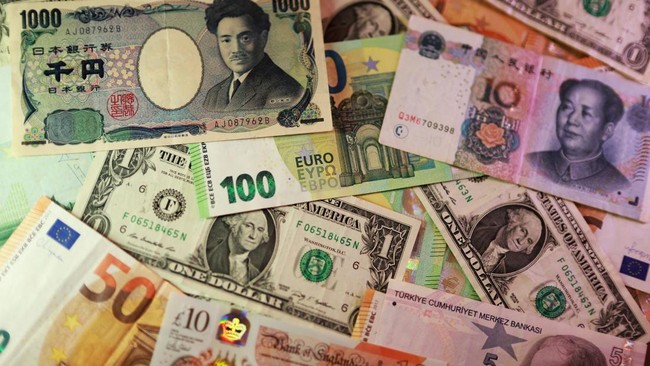
Asian currencies moved in mixed directions during morning trade on Thursday (27/8/2026), amid dynamics in the US dollar’s global market movement following the release of US inflation data last night.
According to Refinitiv data as of 09:16 WIB, of the 10 Asian currencies monitored, five strengthened against the US dollar, while four weakened and one remained stagnant.
The South Korean won was the currency with the sharpest strengthening in Asia this morning. The won appreciated by up to 0.44% to KRW 1,378.77/US$.
The Taiwan dollar followed with a strengthening of 0.34% to TWD 31.735/US.TheSingaporedollaralsostrengthened0.09, followed by the Vietnamese dong which moved positively 0.07% to VND 26,084/US$.
The Chinese yuan also strengthened, albeit marginally, by 0.02% to CNY 6.721/US$.
On the other hand, the rupiah was the currency under the deepest pressure in Asia this morning. The Garuda currency weakened by 0.45% to Rp17,775/US$.
The Malaysian ringgit also corrected 0.07% to MYR 4.025/US, followedbythePhilippinepesowhichweakened0.06. The Japanese yen depreciated slightly by 0.01% to JPY 159.3/US$.
Meanwhile, the Thai baht was observed stagnant at THB 32.81/US$.
Asian currency movements this morning were still influenced by US dollar dynamics. The US dollar index (DXY) at the same time was observed weakening slightly by 0.05% to 99.111.
Although correcting this morning, the US dollar remained near its highest level in the past eight days. The greenback previously received support after US inflation and economic data slightly lifted expectations of an interest rate hike by the US central bank (The Federal Reserve/The Fed).
US Personal Consumption Expenditures Price Index (PCE) data showed inflation rose 3.7% annually in July, unchanged from June and slightly higher than economists’ forecast of 3.6%.
On a monthly basis, PCE rose 0.2%, higher than the market forecast of 0.1%, after falling 0.1% in June.
The data maintained expectations that the Fed still has the opportunity to raise interest rates until the end of the year. However, the market is still waiting for a speech by Fed Chair Kevin Warsh at the Jackson Hole symposium for a clearer picture of the direction of US monetary policy.
Ryan Wells, an economist at Westpac, assessed that Warsh’s speech will be a key test for the direction of market expectations on US interest rates.
“The inflation reading keeps market expectations for a Fed rate hike until the end of the year alive, although Fed Chair Kevin Warsh’s speech at Jackson Hole will be the main test,” Wells wrote, as quoted from Reuters.
Besides the Fed, market attention is also focused on Japan. Market participants are waiting for a speech by Bank of Japan (BOJ) Deputy Governor Ryozo Himino to gauge the likelihood of a Japanese interest rate hike in September.
Expectations of a BOJ rate hike are keeping the yen in market focus. Money markets are pricing in an 87% chance of a BOJ rate hike next month.
Source: jawawa.id (https://jawawa.id/newsitem/rupiah-weakest-in-asia-won-and-yuan-strengthen-against-dollar-1787802666)
Originally published by CNBC Indonesia (https://www.cnbcindonesia.com/research/20260827092124-128-762618/rupiah-paling-loyo-di-asia-won--yuan-justru-perkasa-lawan-dolar), translated from Indonesian