
Rupiah Weakens Today as Garment Manufacturers Put Forward Recommendations
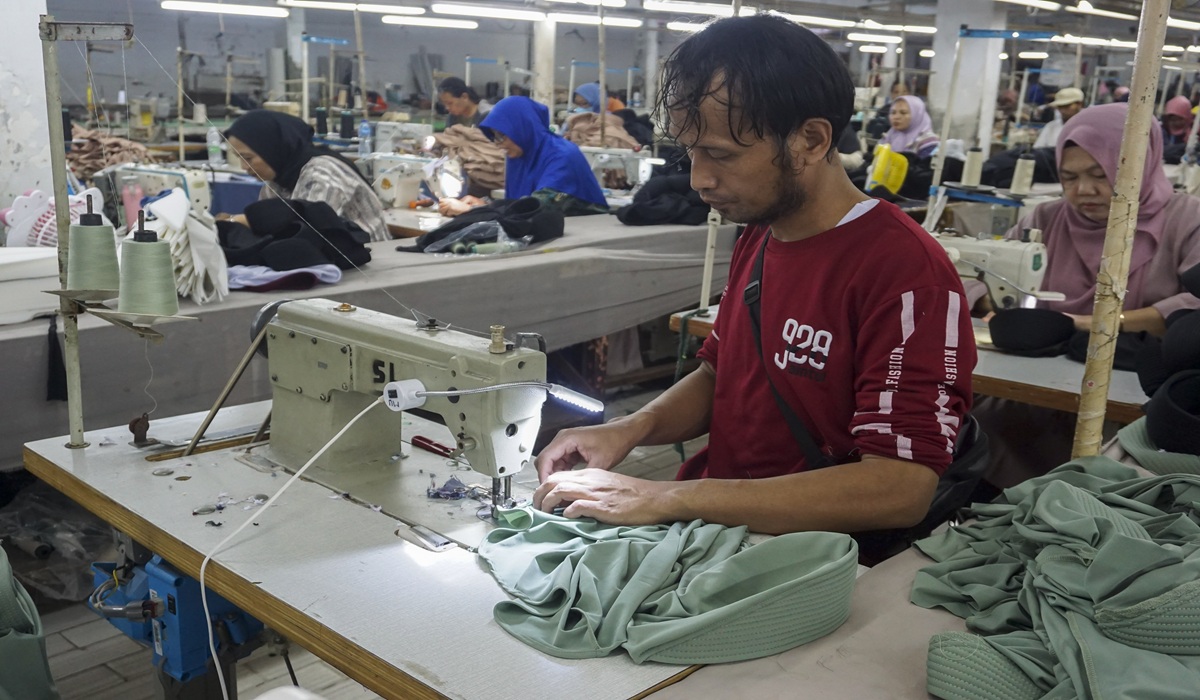
The President is leveraging the momentum of National Awakening Day to safeguard economic stability. The Ikatan Pengusaha Konveksi Berkarya (IPKB) said the rupiah’s depreciation today is being felt acutely by micro, small and medium textile and textile product industries (IKM TPT). IPKB chairman Nandi Herdiaman said the IKM TPT structure remains import-dependent, so every rupiah depreciation immediately raises production costs. On Wednesday 20 May, 1 US dollar stood at Rp17,743.
“A rupiah breaking through Rp17,000 per US$ is not just a Bloomberg screen figure. In Bandung, Solo, and Tegal garment hubs, that means thread prices rise by 15–20%, orders drop, and workers are at risk of being laid off,” Nandi said in a statement on Wednesday 20 May.
Meanwhile, domestically, the market is flooded with cheap illegal goods from abroad via e-commerce. These two pressures squeeze IKM from input to output.
“If this is allowed to continue, it will not only push clothing prices higher, but small factories will close and mass layoffs will occur,” he said.
They appreciate the government and BI for market intervention and for cutting interest rates to maintain stability. But, he said, that is not enough.
According to Nandi, the IKM sector needs concrete steps. IPKB recommends several steps.
First, strengthen local raw material supply. The government should encourage the domestic textile upstream industry so that IKM is not trapped by imports. “Subsidies and incentives for local yarn/fabric mills should be accelerated,” he said.
Second, facilitate IKM exports. This could involve easier access to export programmes, export credit KUR financing, and certification assistance. “Rupiah weak is a momentum, not just a threat,” said Nandi.
Third, ease operating costs. He urged the government to defer or relax the import VAT on raw materials that have no substitutes yet, and to provide industrial electricity relief for IKM.
Fourth, protect domestic markets from cheap illegal goods. He called on the government to tighten oversight and enforcement against illegal imports, mislabelling, and under-invoicing flooding e-commerce.
“Without a healthy domestic market, IKM has no room to grow even if the exchange rate supports it,” he added.
Fifth, maintain policy communication. He stressed that statements by officials move markets. “Consistent, data-based messages make business people calmer,” he said.
“Garment IKM does not want subsidies forever. They want certainty, fair market protection, and room to breathe to adapt. If the government is present at this point, IKM could be a shield against the storm: absorbing labour, maintaining purchasing power, and boosting foreign exchange through exports,” he concluded.
He cited the Habibie era, when the rupiah could fall from around Rp16,800 per US$ to Rp6,500 per US$.
He pointed to the state revenue-to-GDP ratio, which fell sharply to only 9.3% in Q1-2026.
Business circles in Batam have begun to fear the rupiah-to-US$ rate could breach Rp18,000. In this situation, he argued, the central bank must not only control inflation but also maintain confidence in the overall policy direction.
He explained that intervention is not limited to the domestic market but also operates in international markets. The move reportedly contributed to a fall in foreign exchange reserves by about US$10 billion.