
Rupiah Weakens by 0.31%, US Dollar Settles at Rp17,640
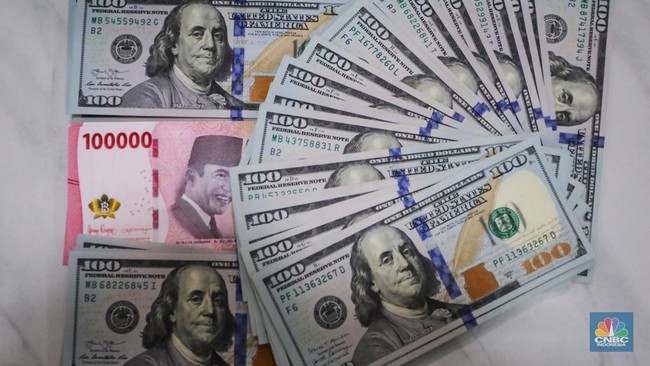
The rupiah exchange rate reversed course to weaken against the US dollar amidst the increasing strength of the US dollar index.
According to Refinitiv data, the rupiah closed 0.31% lower at Rp17,640/US$ in trading on Monday (14/09/2026). This decline continues the pressure on the rupiah, following Friday’s (11/09/2026) close, which also saw a 0.31% correction to the level of Rp17,585/US$.
Despite the decline, the rupiah had initially opened the morning session in the green, strengthening by 0.14% to the position of Rp17,560/US$. However, this strength was short-lived as increasing pressure from the US dollar in global markets caused the rupiah to reverse direction and close in the red.
The rupiah’s movement today remains burdened by the strengthening US dollar. The US dollar index (DXY) was observed to have strengthened by 0.33% to 99.451 as of 15:00 WIB.
The US dollar has regained its footing ahead of a crucial week for global monetary policy. Markets are now awaiting the Federal Reserve’s interest rate decision in the early hours of Thursday (17/09/2026) Indonesian time, as well as the Bank of Japan’s (BOJ) decision on Friday.
Expectations for a Fed rate hike have risen following US consumer inflation data on Friday, which showed prices increasing again in August. According to CME FedWatch, market participants now estimate the probability of a Fed rate hike this week at 86%.
The strength of the US dollar is also supported by rising US government bond yields. The 2-year US Treasury yield, which is sensitive to Fed rate expectations, stands at approximately 4.61% after rising 26 basis points last week.
In addition to interest rates, the market remains shadowed by surging oil prices. Brent crude rose 2% to US$106.7 per barrel after new Houthi attacks on Saudi Arabia and Iranian attacks on ships in the Gulf heightened concerns over energy supply disruptions.
The rise in oil prices has caused global inflation risks to resurface. This condition reinforces the view that major central banks still have reasons to maintain tight monetary policies.
Bank Indonesia (BI) Governor Destry Damayanti also addressed the pressure on the rupiah. She noted that the rupiah had actually moved stronger in recent days, nearly touching the Rp17,400/US$ area.
“In fact, a few days ago, we were at the Rp17,500 level and even nearly touched Rp17,400. However, global volatility has worsened due to the increasing Iran-US conflict, so we (the rupiah) have been somewhat pressured over the last two days. But thankfully, it remains at the Rp17,600 level,” Destry stated during a working meeting with the DPD RI on Monday (14/09/2026).
These statements illustrate that the pressure on the rupiah stems primarily from global factors. The escalation of Middle East conflicts, rising oil prices, expectations of a Fed rate hike, and a strengthening US dollar represent a combination of sentiments limiting the rupiah’s potential for appreciation.
With today’s close, the rupiah has returned to the Rp17,600/US$ area. The market will closely monitor the Fed’s decision this week to determine whether the pressure on the US dollar and emerging market currencies, including the rupiah, will continue or begin to subside.