
Rupiah Weakens Against US Dollar, Exchange Rate Rises to Rp17,275/US$
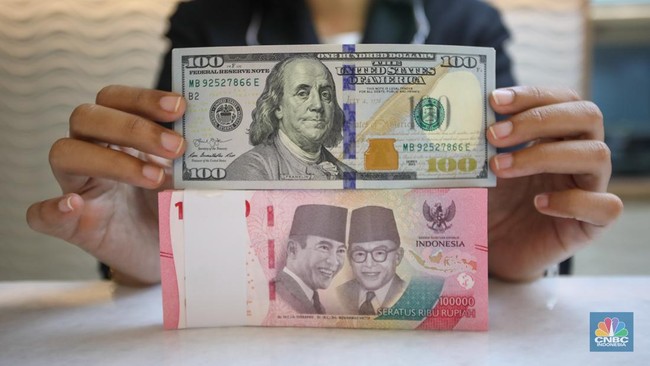
Jakarta, CNBC Indonesia - The rupiah exchange rate closed weaker against the US dollar on Wednesday (29/4/2026) trading session.
According to Refinitiv data, the Garuda currency ended trading at Rp17,275/US, ora0.38.
Pressure on the rupiah was evident from the start of trading. The rupiah opened 0.26% weaker at Rp17,255/US, withtheweakeningdeepeningtotouchRp17, 335/US at one point.
Meanwhile, the US dollar index or DXY at 3:00 PM WIB was observed moving in positive territory, strengthening 0.04% to 98.675.
The rupiah’s weakening on today’s trading is still largely influenced by external factors, particularly the direction of the US dollar in global markets ahead of the US central bank (The Federal Reserve/The Fed) interest rate announcement.
The US dollar tended to strengthen on Wednesday’s trading, in line with investors’ stance awaiting the Fed’s interest rate decision. This meeting is also noteworthy as it is expected to be one of the last moments for Jerome Powell as Fed Chair.
The Fed is widely expected to hold interest rates steady. However, market focus is not only on the rate decision but also on the Fed’s views regarding the impact of the war in the Middle East on the US economy, inflation, and future interest rate direction.
Market participants are also monitoring Powell’s future at the Fed.
Previously, Powell stated that he would remain in place if he perceived the Fed’s independence to be under threat. Therefore, Powell’s future decisions are seen as highly dependent on his perception of the US central bank’s independence.
Besides the Fed agenda, uncertainty from the war in the Middle East continues to be a source of pressure on global markets.
Oil prices rose on Tuesday’s trading as investors assessed that the Iran conflict shows no signs of resolution. News of the United Arab Emirates cutting ties with OPEC has also drawn market attention to the direction of global energy supplies.
The rise in oil prices is also pressuring the US bond market. Bond prices fell, while yields rose, as investors worry that high energy prices could reignite inflationary pressures.
This situation further limits the rupiah’s manoeuvrability. When the US dollar strengthens and investors opt for safe-haven assets, emerging market currencies like the rupiah typically become more vulnerable to pressure.