
Rupiah Weakens Against 10 Currencies, Performing Worst Against Australian and Chinese Dollars
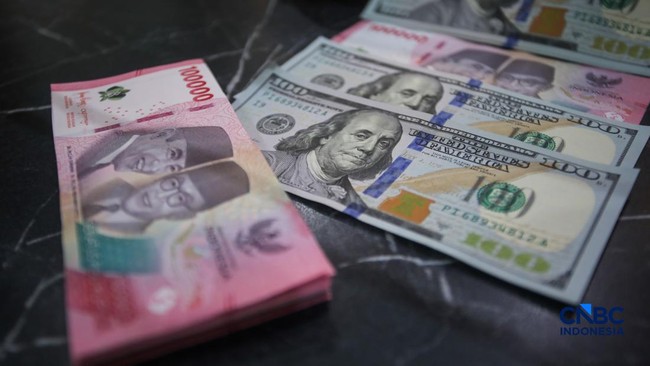
The trend of Rupiah weakening against the US Dollar has once again demonstrated the rapid movements within the foreign exchange market. In a relatively short period, the position of the ‘Garuda’ currency can shift following various market developments.
Referring to Refinitiv data, the Rupiah on Thursday trading (2/9/2026) briefly touched Rp17,900/US.ThisexchangerateapproachedthepsychologicallevelofRp18, 000/US, a level previously touched by the Rupiah. Pressure on the exchange rate was also a key consideration for Bank Indonesia (BI) when raising the BI Rate by a total of 100 basis points between May and June 2026.
Towards the close, the Rupiah improved by 15 points from its weakest position, ending the trading session at Rp17,885/US.Nevertheless, theRupiahstillweakenedby0.51.
Since the beginning of the year, or year-to-date (YTD), the Rupiah’s depreciation against the US Dollar has reached approximately 7.29%, falling from Rp16,670/US$ to Rp17,885/US$.
The Rupiah’s decline occurred as the US Dollar strengthened in the global market. This is reflected in the US Dollar Index (DXY), which returned to the 101 range. The strengthening of the Dollar indicates increased demand for the currency, which in turn exerts pressure on other currencies, including the Rupiah.
While news of the Rupiah weakening against the US Dollar is common, the US Dollar is not the only currency that has strengthened against the Rupiah this year. Compared to several other currencies, the Rupiah’s decline is even more profound.
An analysis of the Rupiah’s performance against various global currencies using Refinitiv data reveals that out of 11 currencies listed, the Rupiah weakened most significantly against the Australian Dollar, dropping 13.16% since the start of the year. The exchange rate has even exceeded Rp12,500 per Australian Dollar. Furthermore, the Rupiah has depreciated significantly against the Chinese Yuan, with an 11.78% decline bringing the rate to Rp2,600 per Yuan.
The Singapore Dollar also exerted pressure, with the Rupiah depreciating by 7.88%, pushing the SGD rate to nearly Rp14,000. These three currencies recorded larger gains against the Rupiah than the US Dollar’s 7.29% increase.
The only exception was the Swedish Krona, against which the Rupiah strengthened slightly by 0.27%. For all other currencies in the list, the Rupiah lost value.
These exchange rate fluctuations are felt when converting the Rupiah into other currencies, particularly for Indonesians facing higher costs for overseas expenses, such as families sending funds for living costs and tuition fees for children studying abroad.
Factors Behind the Weakening Currency
Currency movements are a key metric for market participants assessing Indonesia. Exchange rates are influenced by economic conditions, government policy, and how the market perceives a country’s risk. Therefore, the pressure on the Rupiah this year cannot be separated from both domestic and international developments.
Internationally, the strengthening of the US Dollar and volatility in oil prices have influenced the foreign exchange market.
Domestically, questions regarding the direction of Indonesian policy have intensified. In February 2026, Moody’s changed Indonesia’s credit rating outlook from stable to negative, with Fitch taking a similar step in March. Both agencies maintained Indonesia’s credit rating but lowered the outlook. However, S&P provided a different assessment in July, maintaining Indonesia’s credit rating at the BBB level with a stable outlook, offering a calmer view amidst concerns regarding policy credibility, though not implying that all pressure on the Rupiah has vanished.
The market is also closely monitoring the government’s ability to manage the budget deficit. High oil prices could increase the need for energy subsidies and compensation, while various government programmes continue to require spending. Although the state budget deficit was recorded at Rp240.1 trillion (0.93% of GDP) as of late August 2026—well below the 3% limit—the deficit at the end of 2025 reached 2.81% of GDP. Amid rising oil prices and increased subsidy needs, the market is watching whether the government can keep this year’s deficit below the 3% threshold.
Source: jawawa.id (https://jawawa.id/newsitem/rupiah-weakens-against-10-currencies-performing-worst-against-australian-and-chinese-dollars-1790243802)
Originally published by CNBC Indonesia (https://www.cnbcindonesia.com/research/20260924132742-128-770572/rupiah-keok-lawan-10-mata-uang-ini-paling-buruk-lawan-australia-china), translated from Indonesian