
Rupiah Weakens Again as US Dollar Closes at Rp18,045
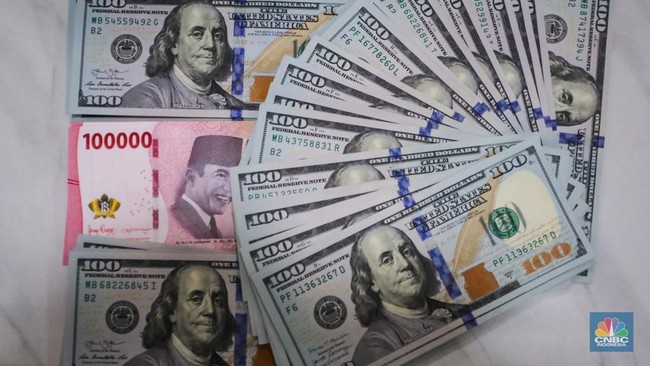
Jakarta, CNBC Indonesia – The rupiah came under renewed pressure against the US dollar at Thursday’s (22 October 2026) close, even as the dollar index weakened.
Refinitiv data showed the rupiah closed at Rp18,045 per US dollar, down 0.25%, or 45 points, from Wednesday’s (21 October 2026) close of Rp18,000 per US dollar.
During the session, the rupiah traded in a range of Rp18,010 to Rp18,050 per US dollar, before ending close to its weakest level of the day.
Meanwhile, the US dollar index (DXY), which measures the greenback against six major currencies, was down 0.20% at 101.575 at 3 pm Western Indonesian Time (WIB).
Although lower, the DXY remained above 101. The US dollar continues to receive support from expectations of resilience in the US economy, including developments in the artificial intelligence (AI) industry, which are also bolstering optimism about economic growth.
The strength of the US economy has also led market participants to expect interest rates to remain high for longer. However, bullish positions on the dollar have begun to ease as several major currencies—including sterling, the Canadian dollar, the Australian dollar and the New Zealand dollar—have strengthened in recent days.
Investors’ attention is now turning to a series of interest-rate decisions by major central banks next week: the Federal Reserve (the Fed), the European Central Bank (ECB) and the Bank of Japan (BOJ).
All three are expected to hold rates steady. Markets will nevertheless scrutinise their statements for clues about the future direction of monetary policy.
The Fed is expected to keep its rate in the 3.75–4.00% range in October, while the possibility of a rise in December remains a focus for markets.
Meanwhile, rising global oil prices have added to investor concerns. Brent crude was reported to have risen by about 2.59% to US$111.64 a barrel amid heightened tensions in the Middle East, fuelling concerns about global energy supplies.
As a net oil importer, Indonesia could face greater demand for US dollars to finance energy imports as oil prices rise, as well as an increased risk of domestic inflation. This is one of the external factors weighing on the rupiah.