
Rupiah Under Pressure and Shares Volatile, KSSK Says Indonesia’s Economy Remains Resilient
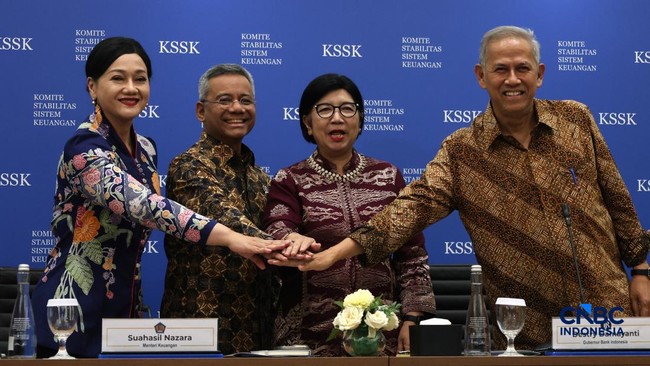
Jakarta, CNBC Indonesia — The Financial System Stability Committee (KSSK) considers Indonesia’s financial system to have remained stable throughout the third quarter of 2026. Despite mounting global pressure and volatility in domestic financial markets, the Indonesian economy is considered resilient, with growth for the year projected at 5.4%–5.5%.
Finance Minister Suahasil Nazara said financial stability had been maintained through close policy coordination and synergy among the fiscal, monetary and financial-sector authorities.
External pressures rose again in October 2026. Escalating geopolitical conflicts, higher global energy prices and the tight monetary policies of advanced economies all affected global financial markets.
Domestically, an announcement by MSCI regarding the condition of Indonesia’s stock market, together with pressure on the rupiah, contributed to increased capital outflows, particularly from the equity market.
“The KSSK, comprising the Finance Minister, the Governor of Bank Indonesia, the Chair of the OJK Board of Commissioners and the Chair of the LPS Board of Commissioners, will continue to monitor developments and conduct forward-looking assessments of the economy and financial sector. We will continue to strengthen cooperation with all stakeholders to anticipate spillover risks from global developments,” Suahasil said at a KSSK press conference in Jakarta on Tuesday (3 November 2026).
Despite these pressures, Indonesia’s economic growth is expected to remain robust. Domestic demand, investment, government consumption and export performance are among the main supports for the economy.
Suahasil said the government was also continuing to optimise the state budget (APBN) as an economic shock absorber. Fiscal measures include subsidies, compensation, social assistance, food-price stabilisation and various job-creation programmes.
Several economic indicators have also shown positive trends. Car sales in September 2026 grew by 28.1% year on year, while motorcycle sales rose by 15.4%.
Manufacturing activity also strengthened. Indonesia’s Manufacturing Purchasing Managers’ Index (PMI) rose from 52 in September to 54 in October 2026.
In light of these developments, the government estimates that Indonesia’s economy could grow by 5.4%–5.5% in 2026.
“To maintain growth momentum, policy coordination between the government and Bank Indonesia, as well as collaboration between the government and Danantara through the ‘two arms of the state’ approach, will continue to be strengthened to maintain stability and drive higher-value-added growth,” Suahasil said.
Third-quarter 2026 state budget performance
On the fiscal front, Suahasil said state budget implementation through the end of the third quarter of 2026 had supported economic growth and the achievement of national development objectives.
State revenue reached Rp2,341.5 trillion, up 25.5% year on year. State expenditure totalled Rp2,660.5 trillion, an increase of 19% compared with the same period a year earlier.
Budget financing through the third quarter of 2026 reached Rp462 trillion, up 0.4% year on year.
Suahasil said budget financing was managed prudently and in a measured manner, while taking the government’s liquidity conditions into account. This approach was intended to safeguard the credibility and accountability of state budget management.
In addition to debt financing, the government is also optimising investment financing to improve public welfare and accelerate various development programmes.
“Investment financing is also managed to improve public welfare and support the acceleration of food, agriculture, housing, education and infrastructure programmes,” Suahasil concluded.
Source: jawawa.id (https://jawawa.id/newsitem/rupiah-under-pressure-and-shares-volatile-kssk-says-indonesias-economy-remains-resilient-1793757040)
Originally published by CNBC Indonesia (https://www.cnbcindonesia.com/news/20261104065937-4-782091/rupiah-tertekan-saham-bergejolak-kssk-ungkap-ekonomi-kondisi-ri), translated from Indonesian