
Rupiah Touches Rp 17,600, Analyst Predicts It Will Breach Rp 18,000 in May 2026
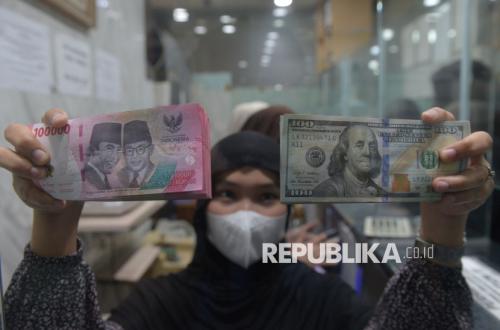
REPUBLIKA.CO.ID, JAKARTA – The exchange rate of the Rupiah against the US dollar continues to weaken, briefly touching the level of Rp 17,600 per US dollar. The Garuda currency is predicted to potentially breach the Rp 18,000 per US dollar level in May 2026.
Quoting Bloomberg, on Friday (May 15, 2026) morning, the Rupiah experienced a weakening of around 73 points or 0.42 percent, moving to the Rp 17,600 level per US dollar. However, as of noon, its position stabilized at the Rp 17,570 level per US dollar.
Meanwhile, the US dollar index has strengthened again, breaching the 99 level. Meanwhile, crude oil prices continue to rise amid the ongoing war in the Middle East. Brent crude oil reached US$106 per barrel, while WTI crude oil reached US$101 per barrel.
Currency and commodity analyst Ibrahim Assuaibi said that the Rupiah experienced pressure during the national holidays on Thursday (May 14, 2026) and Friday (May 15, 2026). This condition is mainly influenced by the escalating conflict in the Middle East.
“During this Easter holiday, Thursday and Friday are indeed a test for Indonesia. We see that during these two days of holiday, there are several geopolitical tensions that continue to escalate, especially in the Strait of Hormuz between the US and Iran,” said Ibrahim in a statement to reporters on Friday (May 15, 2026).
He explained that the large-scale military exercises conducted by Iran in the Strait of Hormuz have created tension for the US. In addition, this situation also has an impact on countries in the Middle East, such as the United Arab Emirates (UAE), Oman, and Saudi Arabia.
In addition, it was reported that during the war, Israeli Prime Minister Benjamin Netanyahu visited the UAE and Saudi Arabia. This also created its own tension.
“Although this has been denied by these countries, this indication is very strong for intelligence that there is cooperation between Israel and countries in the Middle East, especially Saudi Arabia and the UAE,” he explained.
Ibrahim continued, the conflict in the Strait of Hormuz also escalated after an Indian cargo ship from Africa to the UAE sank on Wednesday off the coast of Oman. The perpetrator has not been revealed, so this is also a source of tension in the Middle East.
Several ships were also reportedly detained by Iran after the country conducted large-scale military exercises. Again, tensions in the Middle East are increasing.
Not only the tensions in the Middle East, Ibrahim said that expectations of the monetary policy of the US Central Bank or the Federal Reserve are also one of the factors causing the weakening of the Rupiah. Amid rising gasoline prices, this condition is expected to push up inflation in the US.
“There is a high possibility that in 2026 the US Central Bank will not lower interest rates. This indicates that higher interest rates will have an impact on strengthening the US dollar index, especially coupled with a trade war later,” he explained.
On the other hand, US President Donald Trump held a meeting with Chinese President Xi Jinping in China to discuss the trade war and the Middle East issue. In the meeting, Jinping asked the US not to interfere in the Taiwan issue. If it interferes, it will have an impact on US-China bilateral relations.
The US also said that without the help of China, it is ready to crush Iranian troops in the Strait of Hormuz. This makes the situation even more tense, especially before Trump left for China, the US had imposed sanctions on individuals and companies from China, Hong Kong, the UAE, and Oman that helped channel oil transportation for China.
In the meeting between US and Chinese officials, it was reported that there was a narrative of China’s major agenda to help Iran in terms of weaponry. Iran will save the import of crude oil which has been one of China’s sources of oil imports.
“Well, this is what geopolitically and externally makes the dollar strengthen, oil prices rise, and the Rupiah weakens,” he explained.