
Rupiah Tops 18,000 Against Dollar, IDX Confident in Market Fundamentals
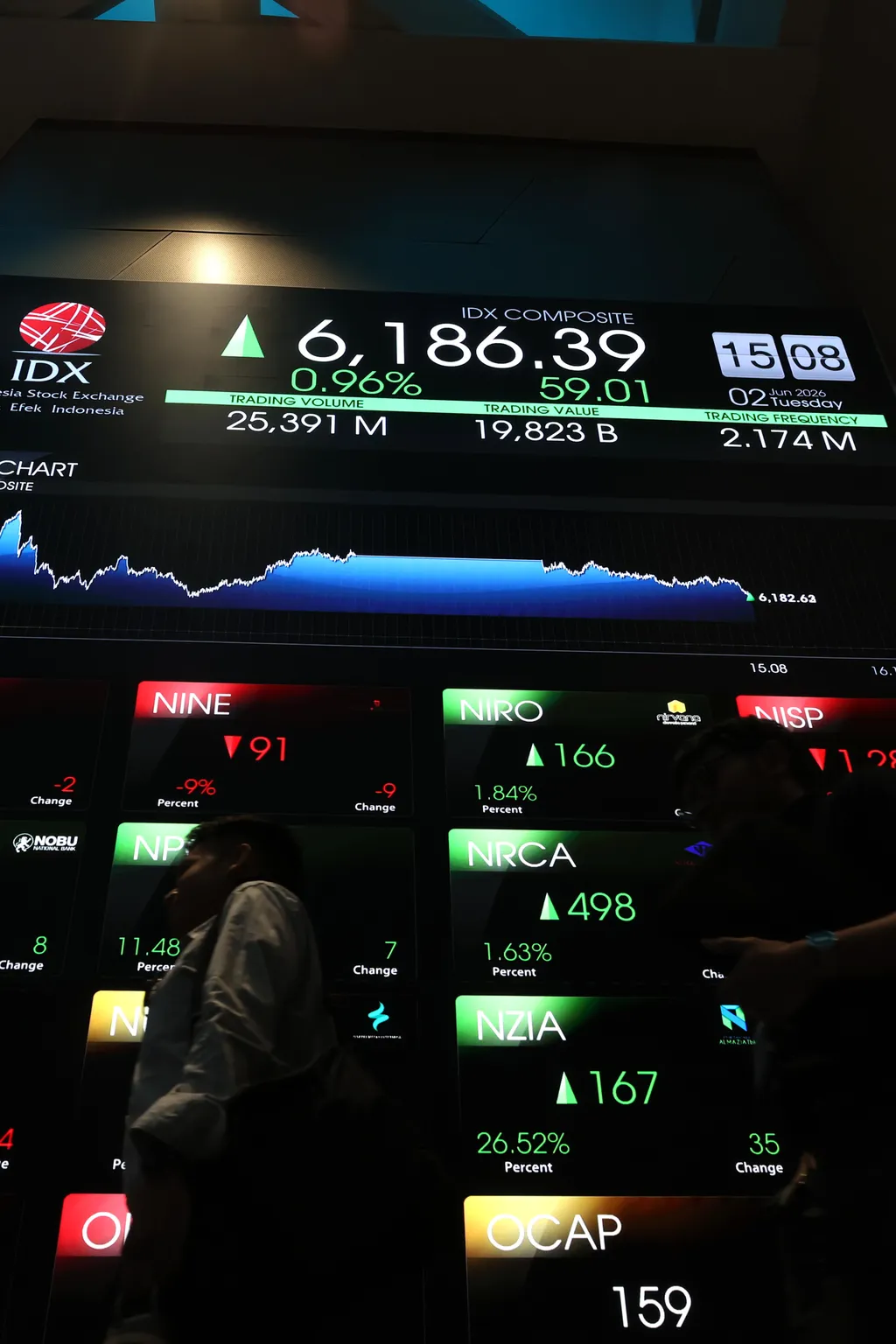
The rupiah’s exchange rate touched Rp 18,000 per US dollar on Thursday (4/6/2026). Citing Bloomberg data, the rupiah weakened to Rp 18,027 against the dollar in Thursday morning trade. Compared to the previous day’s close, the rupiah weakened by 0.34 percent. On a calendar year basis, the rupiah has depreciated by 8.08 percent. The dynamics in the domestic financial market were also driven by foreign capital outflows. Combined data from the Ministry of Finance’s Directorate General of Financing and Risk Management and the Indonesia Stock Exchange (IDX) showed total foreign capital outflows from January to May 2026 reached Rp 69.5 trillion. Responding to this domestic market turmoil, IDX Acting President Director Jeffrey Hendrik reminded investors to make rational investment decisions, pay attention to fundamentals, and invest according to each investor’s risk profile. Regarding Indonesia’s market fundamentals, he explained that the market’s fundamentals are in good condition, as reflected in the financial reports submitted by all issuers. By the end of 2025, all listed companies recorded profit growth of more than 21 percent. Looking at the first quarter of 2026 compared to the first quarter of 2025, stocks in the LQ45 index showed net profit growth of up to 29.9 percent. The LQ45 is an index comprising 45 issuers with high liquidity, the largest market capitalisation, and solid financial fundamentals on the IDX. ‘Furthermore, looking at the net profit distribution for the first quarter of 2026 across all listed companies, 80 percent recorded a net profit. This is the highest percentage in the last five years,’ Jeffrey said in Jakarta on Thursday. In 2020, only 63 percent of listed companies recorded a net profit. From 2021-2025, the proportion was between 73-76 percent. ‘This certainly shows that the fundamentals of our listed companies are currently in good condition. This can certainly be used as a basis for investors to make decisions,’ he said. The existing regulation on share buybacks remains in effect, and the suspension or prohibition of short selling is ongoing. He urged investors to periodically verify information circulating in the market before making decisions, hoping they act based on accurate information. ‘We followed together yesterday that inaccurate information circulated in the market regarding a screenshot, claiming Morgan Stanley Capital International (MSCI) had placed Indonesia in the frontier market, which turned out to be false,’ Jeffrey stated. The IDX hopes Indonesia will remain in the emerging market classification. When asked about any instructions from President Prabowo Subianto regarding the IHSG decline, Jeffrey said the IDX always coordinates with the Financial Services Authority (OJK). The recent volatility is also said not to have affected issuers planning to list in the near future. IDX Corporate Assessment Director I Gede Nyoman Yetna stated all plans remain on schedule. ‘Still on schedule, we have 15 issuers in the pipeline. The process is of course ongoing, we monitor the progress daily,’ Nyoman said. The IDX is pushing for an acceleration of the listing process for prospective companies. The expectation is that the financial statement deadlines can be met. ‘Generally, what is being submitted now from the pipeline uses the December 2025 financial statements, meaning the due date is in June,’ he added. The BRI Danareksa Sekuritas analyst team noted that since 2000, the IHSG has almost never experienced six consecutive monthly ‘red candles’—where the closing price is lower than the opening price. Major correction periods like 2015, 2018, and 2020 only recorded 3-4 months of consecutive declines before eventually recovering, though this occurred six times in 2008. Currently, the IHSG has entered a phase of six consecutive months of decline, matching one of the longest weakening periods in history. Historically, such conditions often occur when the market enters the final phase of a correction or a bottoming process. However, there is no guarantee that a bottom has been formed, as market direction is still influenced by global sentiment, foreign fund flows, and domestic economic conditions. ‘Statistically and historically, the IHSG is currently in a relatively extreme area and has the potential to enter a bottoming phase. However, confirmation of a trend reversal still requires an improvement in sentiment and the emergence of stronger buying pressure,’ the BRI Danareksa Sekuritas team wrote. Economist and public policy expert from UPN Veteran Jakarta, Achmad Nur Hidayat, argued that the government views the rupiah’s weakening as a short-term sentiment disruption, whereas the market sees it as a reflection of medium-term risks. ‘The government must stop treating the rupiah’s weakening as merely a market communication problem. The rupiah weakens because the market doubts the consistency of fiscal policy, spending discipline, financing credibility, and monetary policy independence,’ he said.