
Rupiah Stagnant, Korean Won Strongest Against Dollar This Week
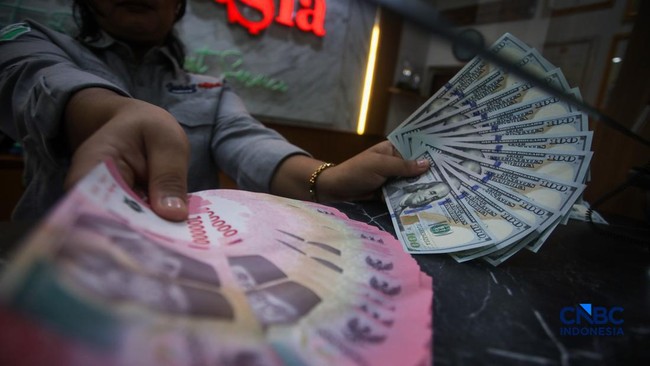
Asian currencies moved in a mixed fashion during trading this week, amid the dynamics of the US dollar in global markets following the release of inflation data and a speech by the Federal Reserve Chairman.
Referring to Refinitiv data as of Friday (28/8/2028), of the 10 Asian currencies monitored, four currencies strengthened against the US dollar. Meanwhile, five currencies weakened and one remained stagnant.
The South Korean won was the currency with the sharpest strengthening in Asia this week. The won managed to appreciate by 0.67% to a position of KRW 1,376.49/US$.
The Taiwan dollar followed with a strengthening of 0.62% to TWD 31.629/US.TheMalaysianringgitalsostrengthened0.32, followed by the Vietnamese dong which moved positively 0.17% to VND 26,070/US$.
Meanwhile, the rupiah remained stagnant at Rp17,685 per US dollar this week.
On the other hand, the baht was the currency with the deepest pressure in Asia this week, weakening by 1.38% to THB 33.12/US$.
The Chinese yuan weakened 0.07% to CNY 6.726/US.ThiswasfollowedbytheSingaporedollarwhichfell0.41 and the Japanese yen which shrank 0.7% to JPY 160.04/US.ThePhilippinepesoalsoslumped0.94.
The movement of Asian currencies this week was still influenced by the dynamics of the US dollar. The US dollar index (DXY) at the same time was observed strengthening 0.91% to a position of 99.702.
The greenback previously received support after US inflation and economic data slightly lifted expectations of an interest rate hike by the US central bank (The Federal Reserve/The Fed).
US Personal Consumption Expenditures Price Index (PCE) data showed inflation rose 3.7% annually in July, unchanged from June and slightly higher than economists’ forecast of 3.6%.
On a monthly basis, PCE rose 0.2%, higher than market expectations of 0.1%, after falling 0.1% in June.
Meanwhile, market participants also responded to a speech by Fed Chair Kevin Warsh at the Jackson Hole symposium to gain a clearer picture of the direction of US monetary policy, which still appears to be hawkish in order to suppress inflationary pressures.
Market participants are projecting a rate hike in September after Warsh said the Fed would “have a lot of work to do” if policymakers are not confident that core inflation is returning to the 2% target, marking his closest statement yet to acknowledging that rate hikes may be needed to cool price pressures.
Market participants now see a 58% chance of a US rate hike in September, compared with 36% before Warsh’s comments, and an 89% chance of a hike in December, according to the CME FedWatch tool.