
Rupiah Slumps, IHSG Staggers: Treating the Root, Not Just the Symptoms, An Islamic Economic Solution
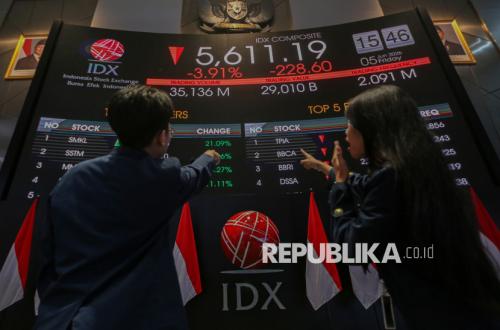
Entering the second week of June 2026, Indonesia’s financial market presented a tense and confusing drama. On 8 June, the rupiah plunged past Rp18,100 per US dollar, the weakest level in history, and year-to-date the Garuda currency has lost nearly nine per cent of its value, making it one of the worst performers in Asia. The Composite Stock Price Index (IHSG) even briefly hit its yearly low at around 5,317, plummeting about 35 per cent in six months, and for a moment held the status of the world’s worst-performing bourse. However, on 9 and 10 June, a sharp reversal occurred. The IHSG soared 7.57 per cent, then followed up with a 2.71 per cent rise to 5,902, whilst the rupiah crawled back to around Rp17,900 per US dollar.
The trigger was a surprise 25 basis point BI Rate hike to 5.50 per cent in an out-of-schedule meeting, coupled with discourse on state-owned enterprise share buybacks. The question then is: does this surge signal that the storm has passed, or is it merely a pause amidst much deeper issues?
The Insan Cita Professors’ Forum (8/6/26), through presentations by professors and economic and monetary experts, concluded that what we are facing is currently a yellow light, not a red one. The fundamental foundation of banking has not yet been shaken, inflation is still under control, and foreign exchange reserves are sufficient for about six months of imports, holding steady so far. What has truly occurred is a market confidence crisis, not a full-blown economic crisis like 1997/1998. The two-day rebound is more accurately read as a relief rally: panic subsided momentarily, but the source of anxiety has not disappeared. Market players remain wary of capital outflows and the persistent shadow of fiscal risk premium.
The root of the turmoil lies in capital flows. Foreign investors sold off shares massively at the start of June, with a recorded net sell of over Rp1 trillion in a single day—triggered by concerns over fiscal policy direction, central bank independence, and capital market transparency. Downgraded outlooks from Moody’s and Fitch worsened sentiment.
Capital outflow is not just a figure on the stock exchange screen; it pressures the rupiah, raises raw material import costs, and ultimately erodes the real sector. When the rupiah weakens, industries dependent on imported components face soaring production costs, squeezed margins, and declining productivity. This is what economists fear: financial symptoms spreading to the heart of the productive economy.
This transmission is now palpable. Starting 10 June 2026, following a surge in world oil prices due to conflict in the Middle East, non-subsidised fuel prices were raised significantly: Pertamax (RON 92) rose 32 per cent to Rp16,250 per litre, and Pertamax Green 95 rose nearly 32 per cent to Rp17,000 per litre. The government held Pertalite and Biosolar prices to protect the purchasing power of vulnerable groups. However, the non-subsidised fuel price hike still risks spreading to logistics costs, food prices, and consumer goods—a domino effect that economist Chatib Basri warned is a direct consequence of the rupiah’s weakening.
For households, this is the most tangible face of the crisis: not exchange rate charts, but market prices. The main concern is not merely temporary inflation, but the inflation expectations that could form if energy price increases are perceived as continuing. Once these expectations harden, business owners and traders tend to raise prices pre-emptively, making the cost spiral increasingly difficult to tame—a pressure that erodes the purchasing power of the middle class, which is precisely the backbone of national consumption.
So, has Bank Indonesia’s move been appropriate? In the short term, BI’s response can be deemed agile. After raising interest rates by 50 basis points in May—the first increase since 2022—BI again surprised the market by raising the BI Rate by 25 basis points to 5.50 per cent on 9 June, accompanied by massive intervention in the foreign exchange market and a Seven Strategic Steps package to strengthen the rupiah. Governor Perry Warjiyo asserted this move was aimed at stabilising the exchange rate amidst global turmoil and maintaining inflation within the 2.5 per cent plus or minus 1 per cent target. The positive market response—the rupiah strengthening and the IHSG rallying—indicates this policy at least succeeded in calming short-term panic.
However, herein lies its limitation. High interest rates do attract portfolio capital back, but simultaneously burden businesses and credit costs—precisely when the real sector is sluggish. The May experience provided an important lesson: BI had already raised rates and intervened, yet the rupiah continued to weaken. This means that monetary policy essentially only buys time. As long as the root problems such as trust in fiscal governance and institutions remain unaddressed, monetary stabilisation only suppresses the symptoms, not cures the disease. In fact, the public questioning of BI’s independence has become part of the trust problem itself.
The Insan Cita Professors’ Forum underscored that stabilising the exchange rate and stock index alone is not enough. Indonesia’s problems are structural: a current account deficit due to dependence on energy and food imports; deindustrialisation shrinking manufacturing’s contribution from 18.4 to 16.9 per cent of GDP, whilst Vietnam accelerates; and extreme inequality, where a handful of accounts control the majority of banking deposits and around one per cent of people control most of the land. Overarching all this looms governance issues: jumbo budget allocations with weak oversight and concerns over oligarchic dominance. Without fixing this foundation, every rebound will be temporary only. Data from the forum even showed near-extreme inequality: about 1.25 per cent of accounts control more than 80 per cent of total banking deposits.