
Rupiah Opens Weaker, US Dollar Climbs to Rp17,840
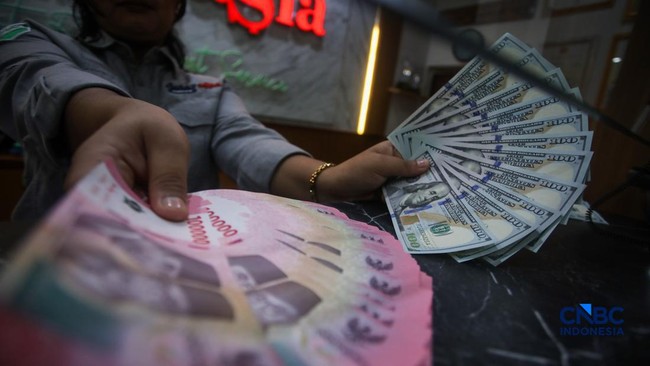
The Indonesian rupiah weakened against the United States dollar in early trading on Wednesday. According to Refinitiv data, the rupiah opened 0.06% lower at Rp17,840 per US dollar. This decline extended the pressure from the previous session on Tuesday, when the rupiah closed 0.45% weaker at Rp17,830 per US dollar, ending a four-day strengthening streak. Meanwhile, the US dollar index, which measures the greenback against six major world currencies, was seen edging up 0.03% to 99.851 at 09.00 WIB. The rupiah’s movement today will continue to be influenced by US dollar dynamics ahead of the announcement of consumer inflation data for July. This data will provide the latest clues for the market in estimating the direction of the US central bank’s interest rate. Market participants remain uncertain after last week’s US employment report was recorded as weaker than expected. The slowing labour market conditions open the door for the Federal Reserve to hold interest rates, but inflation risks still limit the chances of policy easing. Chicago Fed President Austan Goolsbee stated that the central bank is currently more concerned about inflation being too high than about a weakening labour market. The statement has kept the market cautious ahead of the inflation data release. Markets are now pricing in a 52% chance that the Fed will maintain interest rates at its September meeting, while the probability of a 25-basis-point rate hike stands at 48%. Inflation risks have also increased again after oil prices moved higher following attacks on a key shipping route in the Middle East. Rising energy prices have the potential to keep price pressures elevated and maintain support for the US dollar. Meanwhile, the rupiah has also not received strong support from retail sales data. Indonesian retail sales were still contracting by 3% year-on-year in June 2026, marking a decline for three consecutive months. Although this improved from the 3.9% contraction in May, the realisation was still far below initial estimates which pointed towards 1.8% growth. The data indicates that domestic consumption momentum has not fully recovered, serving as a sentiment that limits the rupiah’s movement. However, pressure from this data was restrained by a monthly improvement. The Real Sales Index rose 0.7% to 225.0 after falling 1.5% in May, supported by public demand during the National Religious Holiday period and school holidays.