
Rupiah Opens Weaker as US Dollar Rises to Rp17,635
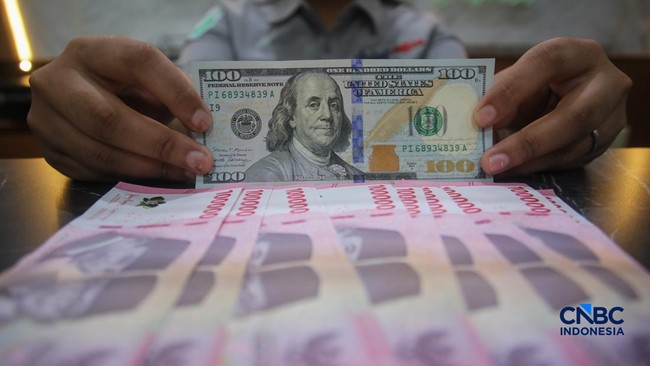
The rupiah opened marginally weaker against the US dollar in morning trading, even as the US dollar index was undergoing a fairly deep correction.
According to Refinitiv data, at the opening of trade on Tuesday (8/9/2026), the rupiah slipped 0.03% to Rp17,635/US, weakeningby5pointsfromMonday′sclose(7/9/2026), whichwasstagnantatRp17, 630/US.
Meanwhile, the US dollar index (DXY), which measures the greenback’s strength against six major world currencies, was down a considerable 0.39% to 98.789 at 09.00 WIB.
The rupiah remained range-bound and has yet to capitalise on the positive impetus from the dollar’s weakness in global markets. Market participants are awaiting US inflation data due to be released this Friday.
The data represents the last in a series of key economic indicators before the US central bank (the Federal Reserve/The Fed) holds its FOMC meeting on 15-16 September.
Following last Friday’s stronger-than-expected US jobs report, market players are now pricing in a roughly 60% chance that the Fed will raise interest rates this month.
Inflation running higher than forecast could strengthen the odds of a Fed rate hike and lift the US dollar once more. Such a scenario would potentially add pressure on the rupiah.
Conversely, lower inflation could reduce expectations of US monetary tightening, weigh on the dollar, and open room for the Garuda currency to strengthen.
Markets are also monitoring geopolitical tensions in the Gulf region after Iran threatened to retaliate against any new US attack on its assets. Iran also warned that energy infrastructure in the Gulf, including US oil and gas interests, is in a vulnerable position.
These tensions have kept oil prices hovering around six-week highs. Brent crude is even trading above US$97 per barrel.
Rising oil prices could amplify global inflationary pressure and influence the direction of Fed policy. For Indonesia, an oil-importing country, high energy prices could also increase foreign exchange needs for imports and limit room for the rupiah to strengthen.
The rupiah has in fact received support from an increase in Indonesia’s foreign exchange reserves. Bank Indonesia (BI) recorded foreign reserves at the end of August 2026 at US$146.5 billion, up from US$145.3 billion at the end of July.
That position is equivalent to financing 5.4 months of imports, or 5.3 months of imports and payments of the government’s external debt. Adequate foreign reserves can support the resilience of the external sector while strengthening BI’s room to safeguard rupiah stability.