
Rupiah Opens Weaker as US Dollar Hits Rp17,920 This Morning
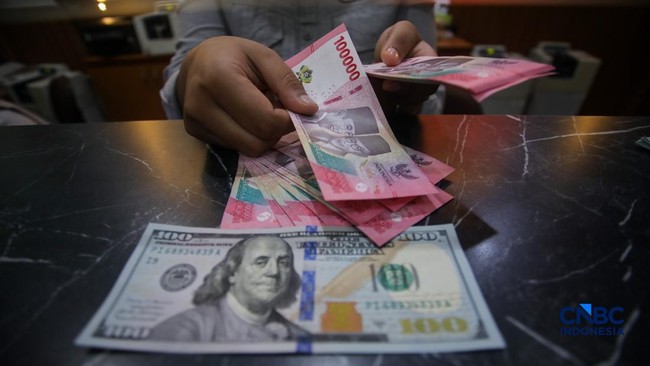
The rupiah exchange rate lost momentum against the US dollar at the opening of trading early this week.
According to Refinitiv data, at the start of trading on Monday (28/09/2026), the rupiah depreciated by 0.22% to the level of Rp17,920/US.ThismovementreversestheslightgainsseenonFriday(25/09/2026), whentherupiahmanagedtorecoverfrompressureandclosedup0.03.
Meanwhile, the US Dollar Index (DXY), which measures the strength of the greenback against six major world currencies, weakened by 0.31% to the level of 100.971 at the close of last Friday.
The rupiah’s movement in today’s trading and over the coming week is expected to remain influenced by both domestic and international sentiments. Domestically, market players are awaiting the release of Indonesia’s September inflation data on Thursday (01/10/2026). The data to be announced includes annual inflation, core inflation, and monthly inflation. Inflation developments will serve as a key reference for Bank Indonesia (BI) in determining its next monetary policy direction.
In August, annual inflation rose to 3.19% from 2.28% in July, exceeding market expectations of 3.13%. Core inflation also rose to 2.92%, the highest since March 2023, while monthly inflation was recorded at 0.21%. The September data will be scrutinised to measure price pressure developments and the scope for BI’s monetary policy. Inflation that remains controlled within the 1.5%-3.5% target could allow for more accommodative policies. Conversely, a rise in core inflation could limit the room for interest rate easing.
Externally, the direction of the US dollar remains a primary focus. As reported by Reuters, the greenback weakened on Friday after global oil prices fell by more than 2% and market participants took profits after the dollar had strengthened for four consecutive days. Oil prices fell amid hopes of a ceasefire between the US and Iran. These hopes have temporarily eased concerns regarding supply disruptions caused by increased attacks by Houthim groups against Saudi Arabia.
Nevertheless, oil prices remain above US$100 per barrel. This level continues to potentially maintain global inflationary pressures and influence the interest rate policy directions of several central banks. Despite the correction on Friday, the DXY still recorded its second consecutive weekly gain. Expectations of interest rate hikes by the US Federal Reserve (The Fed) and high US Treasury yields continue to support the US dollar.
“The dollar has not truly weakened materially. Its movement is simply taking a pause,” said Eugene Epstein, Head of Trading and Structured Products at Moneycorp.
Based on CME FedWatch, the market is pricing in approximately a 66% chance that the Fed will raise interest rates again at its October meeting, an increase from around 58% a week earlier. Expectations for re-tightening strengthened after several Fed officials expressed concerns regarding inflation. Cleveland Fed President Beth Hammack warned that inflation persisting above the 2% target could reduce public confidence in the central bank’s ability to control prices.
US economic data also continues to show resilience. US new orders for capital goods in August increased more than expected, while the previous month’s data was revised sharply upwards. This condition indicates that business spending remains strong and could strengthen the rationale for the Fed to maintain a tight monetary policy.