
Rupiah Opens Weak, US Dollar Approaches Rp18,000 Again
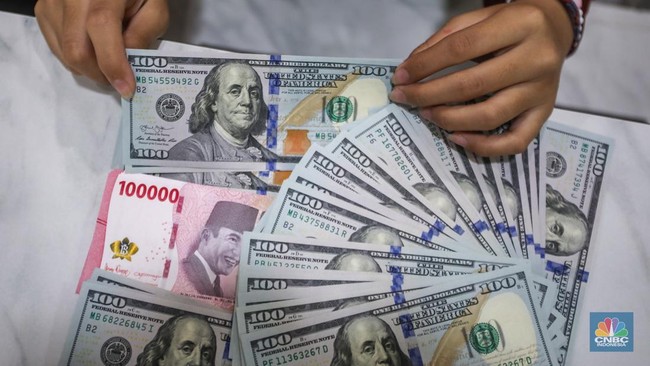
The rupiah exchange rate opened weaker against the US dollar at the start of trading this week, Monday (6/7/2026).
According to Refinitiv data, the Indonesian currency opened weakly, depreciating by 0.12% to the level of Rp17,970/US$.
This decline follows the close of the previous trading week on Friday (3/7/2026), where the rupiah had managed to strengthen by 0.24% to a position of Rp17,945/US$.
Meanwhile, the US Dollar Index (DXY), which measures the strength of the greenback against six major world currencies, was observed to have strengthened by 0.09% to the level of 100.946 as of 09:00 WIB.
The movement of the rupiah at the beginning of this week is expected to remain influenced by both external and domestic factors.
Externally, the direction of the US dollar in the global market remains a primary focus. The US dollar moved steadily near its two-week low after market participants began reducing expectations for interest rate hikes by the US central bank, the Federal Reserve (The Fed), this year.
Last week, the US dollar recorded its deepest weekly decline since April. This correction occurred after US labour reports showed a sharp slowdown in job growth in June, thereby easing market expectations regarding the likelihood of a Fed rate hike.
Nevertheless, pressure on the rupiah still warrants close monitoring, particularly from the domestic side. One area of market concern is Indonesia’s trade balance, which has returned to a deficit after maintaining a surplus for six years.
Statistics Indonesia (BPS) previously recorded that Indonesia’s trade balance experienced a deficit of US$1.61 billion in May 2026. This deficit ended an export-import surplus trend that had lasted for 72 consecutive months since May 2020.
Economists from Bank Central Asia (BCA) assess that pressure on exports could continue in the future. Several hindering factors include the more hawkish direction of Fed policy, the potential for a slowdown in global demand, the mandatory B50 biodiesel programme which could affect CPO export allocations, and policy uncertainty regarding commodities such as coal and nickel.
Additionally, imports are also expected to potentially increase. High levels of government spending are considered capable of offsetting the impact of rupiah depreciation on import demand.
“The combination of these factors creates a feedback loop leading to rupiah weakness, which we expect will be addressed with an additional 50 bps increase in the BI policy rate this year,” wrote BCA economists Jennifer Calysta Farrell and Victor George in the July 2, 2026, edition of BCA Economic and Industry Research.