
Rupiah Opens Higher as US Dollar Falls to Rp17,860
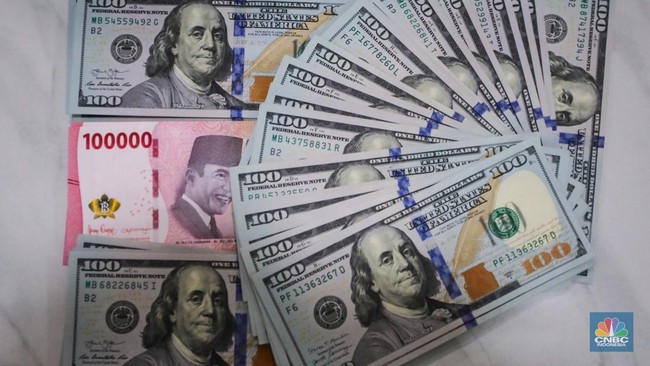
Jakarta, CNBC Indonesia – The rupiah opened stronger against the US dollar on Monday (12 October 2026).
Refinitiv data showed the currency began trading up 0.08%, appreciating to Rp17,860 per US dollar.
The gain extended the rupiah’s movement at the end of last week. On Friday (9 October 2026), it closed 0.08% higher at Rp17,875 per US dollar, although that was a smaller gain than its 0.20% rise at the open, when it stood at Rp17,855 per US dollar.
Meanwhile, the US Dollar Index (DXY), which measures the greenback against six major currencies, was down 0.12% at 102.130 at 9am Western Indonesian Time (WIB).
The dollar index’s decline gave the rupiah room to extend its gains in early trading. However, the DXY’s continued position above 102 indicated that the US dollar remained relatively strong in global markets.
Amid continued global uncertainty, Bank Indonesia (BI) has reiterated its readiness to intervene more aggressively to maintain rupiah stability.
BI Governor Destry Damayanti said the central bank could take such action if renewed pressure from global markets affected the domestic exchange rate.
“If we need to intervene more boldly, we will, because we can see that the main source of this volatility is largely global,” Destry said on CNBC Indonesia’s Central Banking programme, as quoted on Friday (9 October 2026).
Destry explained that ongoing tensions in the Middle East could still drive oil prices higher. This could strengthen the US dollar while adding pressure on the rupiah.
However, she said the domestic economy was currently relatively more manageable. One source of support was Indonesia’s trade balance, which recorded a surplus of US$3.3 billion.
“Domestically, things are relatively more manageable. For example, our trade balance recorded a surplus of as much as US$3.3 billion, a significant jump. But it was also expected, because commodity prices rose substantially, boosting our commodity exports,” Destry said.
BI will also continue to monitor the currencies of countries in the region with characteristics broadly similar to Indonesia’s, including the Philippine peso and Thai baht.
“Ultimately, everyone compares one country with another. We look at how other currencies are performing – for example, the Philippine peso and the Thai baht – at least in countries whose characteristics are broadly similar to ours,” Destry said.