
Rupiah Loses to Seven of Eight ASEAN Currencies, Faring Worst Against the Cambodian Riel
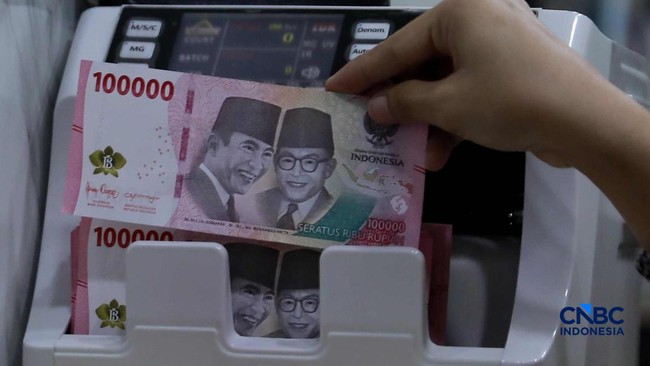
Jakarta, CNBC Indonesia — The rupiah has had a difficult year in 2026.
In addition to weakening against major global currencies, the Garuda currency has also remained under pressure against those of its neighbours in South-east Asia (ASEAN).
Refinitiv data for intraday trading on Thursday (22 October 2026) at 12.32 pm Western Indonesian Time showed that, of the eight ASEAN currencies tracked, the rupiah had fallen against seven and strengthened against only one: the Thai baht.
Its steepest decline was against the Cambodian riel, falling 0.39% to Rp4,427 per KHR.
The Singapore dollar was the next source of pressure. The rupiah weakened 0.32% to Rp14,123 per SGD, after briefly touching a new all-time low of Rp14,135 per SGD.
The rupiah also fell 0.27% against the Malaysian ringgit, to Rp4,416.50 per MYR.
It weakened by 0.30% against the Vietnamese dong, followed by declines of 0.22% against the Myanmar kyat and 0.21% against the Lao kip.
The fall against the Philippine peso was more limited, at 0.10%, taking the exchange rate to Rp284.07 per PHP.
Against that broad-based pressure, the Thai baht was the only ASEAN currency against which the rupiah gained. The Garuda currency edged up 0.09% against the baht to Rp535.41 per THB.
Rupiah trails all ASEAN currencies in 2026
The picture is more troubling when the exchange-rate movements are considered from the start of the year, or year to date (YTD).
The rupiah has depreciated against all eight ASEAN currencies tracked, with no gains recorded against any of them.
Its sharpest year-to-date fall was against the Vietnamese dong, at 10.2%. The dong has therefore made the largest gain against the rupiah among the ASEAN currencies tracked this year.
The rupiah has also come under significant pressure against the Singapore dollar, depreciating 9.0% YTD.
Other declines were 8.2% against the Myanmar kyat and 7.8% against the Malaysian ringgit.
Although the ringgit was not at the top of the list, the rupiah’s fall against Malaysia’s currency was substantial, particularly given the close trade ties between the two neighbouring countries.
The rupiah also lost 6.6% against the Cambodian riel from the start of the year.
Pressure on the Garuda currency was also evident against the Lao kip, against which it depreciated 4.0%.
Against the Thai baht, the rupiah was down 1.2% YTD. This means its modest gain against the baht during Thursday’s midday trading has not reversed the losses accumulated since the start of the year.
The Philippine peso recorded the smallest gain against the rupiah among the ASEAN currencies, with the rupiah down just 0.4% YTD.
The movements show that pressure on the rupiah in 2026 has extended beyond the US dollar to the currencies of neighbouring countries.
All eight ASEAN currencies tracked remain stronger against the rupiah than at the start of the year, with the Vietnamese dong and Singapore dollar showing the largest gains.
Why does the rupiah keep weakening?
The conflict between the United States and Iran, which has continued since the start of the year, has kept global oil prices elevated.
Brent crude was still above US$100 a barrel in October 2026, amid concerns that energy supplies from the Middle East could be disrupted.
This poses a challenge for Indonesia, which still needs to import oil and fuel to meet domestic demand.
When oil prices rise, Indonesia has to spend more to buy energy from abroad. Demand for foreign currency may consequently increase, adding pressure to the rupiah.
Several other ASEAN countries also face the burden of expensive energy, particularly those that rely on oil imports, such as Thailand and the Philippines.
But pressure on the rupiah is not solely external. Domestic issues have also made investors more cautious about placing funds in Indonesia’s financial markets.
Fiscal concerns and weaker credit outlook
Since the start of 2026, the Indonesian government’s finances have drawn investors’ attention, particularly after the 2025 state budget deficit swelled close to the statutory ceiling.
According to the Finance Ministry, the 2025 deficit reached Rp695.1 trillion, equivalent to 2.92% of gross domestic product (GDP).
That was a considerable increase on the 2024 deficit, which stood at 2.30% of GDP.
This has raised concern that Indonesia’s budget deficit in 2026 could exceed the 3% of GDP limit, particularly amid substantial government spending needs and higher energy prices resulting from the war in the Middle East.
Fiscal concerns have coincided with greater investor scrutiny of the government’s economic policy direction.
The situation was compounded when two international credit-rating agencies, Moody’s and Fitch Ratings, changed Indonesia’s credit outlook from stable to negative.
This prompted many market participants to sell Indonesian financial instruments.
When foreign investors sell rupiah-denominated assets and move their funds overseas, demand for foreign currency may rise, putting further pressure on the rupiah.
MSCI turmoil undermines investor confidence
Alongside fiscal issues, Indonesia’s financial markets are facing serious concerns over transparency and governance in share trading.
The issue came to the fore in January 2026, when global equity-index provider Morgan Stanley Capital International (MSCI), whose indices are used as benchmarks by many international investors, questioned the disclosure of share ownership in Indonesia.
On 27 January 2026, MSCI announced a temporary freeze on certain adjustments to Indonesian equity indices.
It cited continuing concerns over transparency in share-ownership structures, including fears of coordinated trading that could mean share prices were not being formed fairly.
The announcement immediately shook Indonesia’s stock market. MSCI also warned that Indonesia risked being downgraded from Emerging Market to Frontier Market status if transparency did not improve sufficiently.
In October, however, MSCI opened a consultation on changing Indonesia’s equity-market classification from Emerging Market to Standalone Market, a category below Frontier Market.
That could prompt investors tracking MSCI indices to reduce their holdings of Indonesian shares, potentially adding to pressure on the rupiah.
This also helps explain why the rupiah’s weakness in 2026 has extended beyond the US dollar to all eight of the neighbouring countries’ currencies tracked.
Source: jawawa.id (https://jawawa.id/newsitem/rupiah-loses-to-seven-of-eight-asean-currencies-faring-worst-against-the-cambodian-riel-1792662664)
Originally published by CNBC Indonesia (https://www.cnbcindonesia.com/research/20261022124910-128-778573/rupiah-keok-lawan-7-dari-8-mata-uang-asean-terburuk-vs-riel-kamboja), translated from Indonesian