
Rupiah Leads Asian Currencies as US Dollar Weakens
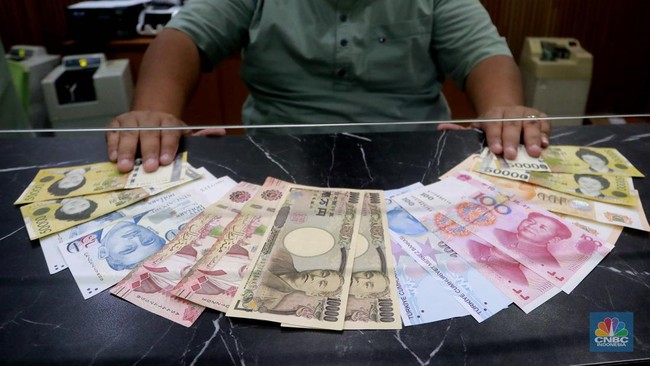
Most Asian currencies strengthened against the US Dollar in trading on Thursday (3/9/2026). The weakening of the US Dollar this morning provided space for regional currencies to move into positive territory.
According to Refinitiv data as of 09:18 WIB, out of the ten Asian currencies monitored by CNBC Indonesia, seven managed to strengthen against the greenback, while two weakened and one remained stagnant.
The Rupiah was the currency with the sharpest appreciation in Asia this morning, gaining 0.31% to reach Rp17,695/US$.
The Japanese Yen followed with a 0.25% gain to JPY 158.3/US.TheThaiBahtalsoappreciatedby0.18, followed by the Malaysian Ringgit, which rose 0.17% to MYR 4.036/US$.
The Philippine Peso also strengthened by 0.09% to PHP 62.474/US, whiletheChineseYuansawaslightgainof0.02, and the Taiwan Dollar rose by 0.01%.
On the other hand, the Vietnamese Dong experienced the deepest pressure in Asia this morning, weakening by 0.08% to VND 26,090/US$.
The South Korean Won also declined by 0.03% to KRW 1,358.85/US, whiletheSingaporeDollarremainedstagnantatSGD1.27/US.
The positive performance of most Asian currencies aligns with the weakening US Dollar. The US Dollar Index (DXY) as of 09:17 WIB fell 0.06% to the level of 99.537.
The decline in the US Dollar was primarily influenced by the sharp strengthening of the Japanese Yen. The Yen received a boost as markets closely monitored the possibility of a rate check by Japanese authorities, following previous pressure that saw the Yen weaken past the psychological level of 160 per US Dollar.
The Yen’s strength also occurred after Bank of Japan (BOJ) board member Hajime Takata stated that the Japanese central bank needs to raise interest rates agilely to respond to increasing inflationary pressures.
BOJ Governor Kazuo Ueda had previously signalled strongly that the central bank would discuss the possibility of an interest rate hike at this month’s meeting. These statements have led the market to re-examine the direction of Japanese monetary policy.
“This is a significant movement and could be an opportune time for either the US or Japan to at least conduct a rate check, following the BOJ comments this morning,” said Chris Scicluna, head of economic research at Daiwa Capital Markets Europe, as quoted by Reuters.
Despite the weakening US Dollar, its downward pressure remains constrained by several factors. Rising oil prices and high US Treasury yields had supported the greenback in previous trading sessions.
Brent crude prices rose by approximately 1% following renewed tensions in the conflict between the US and Iran. These tensions have raised concerns regarding global oil supplies and global inflation risks.
“The market is clearly concerned about the recent US-Iran developments,” said Eric Theoret, currency strategist at Scotiabank, as quoted by Reuters.
Rising oil prices have the potential to keep US inflation high. This condition has led the market to once again factor in the possibility of an interest rate hike by the US Federal Reserve (The Fed).
Fed funds futures estimate the probability of a Fed rate hike in September at 63%. This figure has risen from 35% prior to the speech by Fed Chair Kevin Warsh at Jackson Hole last week.
With the US Dollar weakening this morning, most Asian currencies successfully entered the green zone.