
Rupiah Leads Asia in Pushing Back Against US Dollar, Ringgit Left Behind
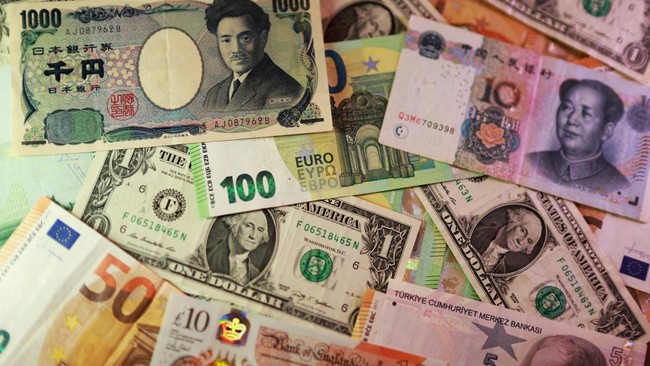
Jakarta, CNBC Indonesia - Asian currencies appeared quite strong against the United States (US) dollar in morning trade today. The dollar’s weakening in recent days has provided room for almost all Asian currencies to strengthen, including the rupiah.
Referring to Refinitiv data, in trading on Wednesday (5/8/2026) as of 09:16 WIB, nine out of 10 Asian currencies were seen moving stronger against the US dollar. Only one currency remained stuck in the red zone.
The rupiah became the currency with the highest strengthening in Asia this morning. The Garuda currency strengthened 0.44% to a position of Rp17,935/US.ThisstrengtheningpushedtherupiahfurtherawayfromthepsychologicallevelofRp18, 000/US.
The South Korean won followed with a 0.42% increase to KRW 1,422.9/US.TheTaiwandollaralsostrengthenedquitesharply, by0.31.
The Philippine peso also rose 0.11% to PHP 60.901/US, whiletheChineseyuanstrengthened0.09.
The Japanese yen and Thai baht strengthened 0.07% and 0.06%, respectively. Thinner gains were seen in the Vietnamese dong and Singapore dollar, which both rose 0.02%.
On the other hand, the Malaysian ringgit was the only Asian currency to weaken. The ringgit fell 0.10% to MYR4.089/US$.
The strengthening of almost all Asian currencies this morning occurred amid dynamics where the US dollar still tended to be depressed in recent days. The US dollar index (DXY) at the same time was indeed observed to have strengthened slightly by 0.03% to 99.888.
However, this slight increase was not enough to change the major direction of the US dollar’s movement. The DXY was still moving below the 100 level and struggling to find direction after touching its lowest level in six weeks on Monday.
Pressure on the US dollar was also influenced by the decline in oil prices. Oil prices weakened again in Wednesday morning trading below the US$80 per barrel level, after having plunged 5% in the previous session.
The decline in oil prices occurred due to emerging signs of a potential diplomatic path in the Iran conflict. These hopes eased market concerns about energy supply disruptions and encouraged market players to shed the risk premium previously attached to oil prices.
Qatar stated on Tuesday that mediators were beginning to note progress in efforts to end the war. This hope also strengthened expectations that oil flows through the Strait of Hormuz could improve.
For the US dollar, the fall in oil prices is a particular pressure. Lower energy prices can ease inflation concerns, so the market has begun to lower expectations for an interest rate hike by the US central bank (The Federal Reserve/The Fed).
This is also visible from the yield on two-year US Treasury notes, which is moving around its lowest level in two weeks. This instrument is sensitive to the direction of interest rates, so its weakening indicates the market is recalculating the probability of a Fed rate hike in September.
Citing CME FedWatch, the probability of a Fed rate hike in September fell to 60%, from 75% last week.
The market’s focus will now shift to US labour data, especially the nonfarm payrolls to be released on Friday. This data will be an important clue for reading the condition of the US labour market and the Fed’s next policy direction.