
Rupiah Leads Asia in Pushing Back Against Dollar: Won, Yen, and Ringgit Also Strengthen
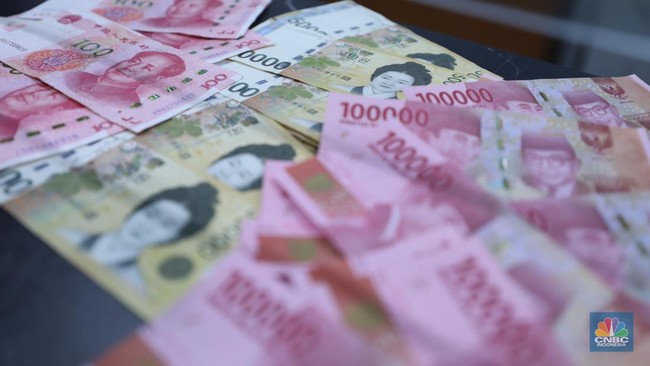
Jakarta, CNBC Indonesia - The majority of Asian currencies strengthened against the United States dollar at the start of the week on Monday (15/6/2026). The rally occurred as the dollar weakened in global markets following positive news from the US-Iran peace process.
According to Refinitiv data as of 09:15 WIB, nine out of ten monitored Asian currencies appreciated against the dollar, while only one weakened.
The rupiah led the gains in Asia this morning. The Garuda currency appreciated 0.92% to Rp17,700/US$, a position that makes it increasingly positive for a potential trend reversal towards strengthening against the greenback.
The rupiah’s gain was followed by the Thai baht, which rose 0.43% to THB 32.55/US.TheSouthKoreanwonalsostrengthened0.37.
The Taiwan dollar appreciated 0.27% to TWD 31.524/US, theSingaporedollarrose0.18, and the Malaysian ringgit strengthened 0.17% to MYR 4.048/US$.
The Chinese yuan also appreciated 0.07% to CNY 6.758/US.ThePhilippinepesorose0.10, while the Japanese yen edged up 0.01% to JPY 160.2/US$.
The only Asian currency to weaken this morning was the Vietnamese dong, which corrected slightly by 0.02% to VND26,255/US$.
Meanwhile, the US dollar index (DXY), which measures the greenback’s strength against six major world currencies, was observed weakening 0.17% to 99.578 at the same time. This dollar weakness was one of the factors providing room for other currencies, including those in Asia, to strengthen.
The dollar weakened against a number of major currencies after the United States reportedly agreed to a peace deal with Iran. This news caused oil prices to drop sharply and revived investor appetite for riskier assets.
US and Iranian officials said on Sunday that both parties had agreed on a framework to end the war, halt the US blockade against Iran, and reopen the Strait of Hormuz. In response to the news, oil prices fell, with Brent weakening more than 4% to US$83.82 per barrel.
The decline in oil prices is a positive sentiment for the market as it can ease energy inflation concerns. When inflation risks subside, expectations for interest rate hikes by central banks, including the US Federal Reserve, also diminish.
Nevertheless, market participants remain cautious. US President Donald Trump told the New York Times on Sunday that if Iran fails to reach a final nuclear deal with the US, he will launch military strikes on Tehran again or make the US the ‘guardian of the Middle East’ in exchange for 20% of the region’s revenue.