
Rupiah Is Asia’s Worst Performer as Ringgit and Won Fall; Only Vietnam Gains
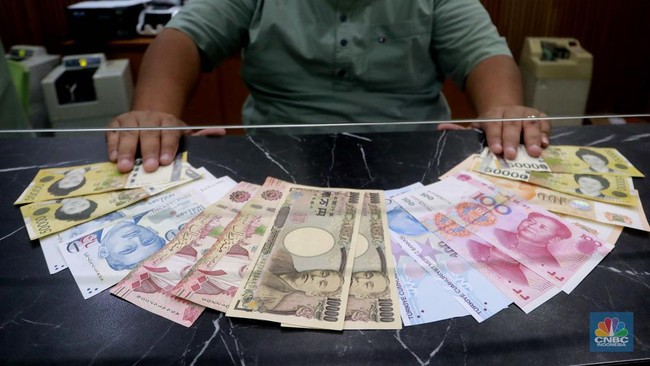
Pressure returned to most Asian currencies against the US dollar in trading on Friday, 16 October 2026, the final session of the week.
Refinitiv data at 09:20 WIB showed that eight of the 10 Asian currencies monitored had weakened against the US dollar. One currency strengthened and another was unchanged.
The rupiah was Asia’s worst-performing currency that morning, falling sharply by 0.84% to breach Rp18,070 per US dollar.
The Taiwan dollar followed with a 0.40% decline, while the South Korean won fell 0.29%. The Thai baht weakened by 0.09%, the Singapore dollar fell 0.06%, the Philippine peso slipped 0.03% and the Malaysian ringgit declined 0.02%. The Japanese yen also edged down by 0.01%.
Against this backdrop, the Vietnamese dong was the only Asian currency to gain, rising 0.05%. The Chinese yuan was unchanged.
The US dollar was slightly weaker in morning trading. The US Dollar Index (DXY) was down 0.03% at 102.027.
That level was still considered high: the DXY remained above 102 after reaching an 18-month high in recent days.
Investors have begun scaling back expectations that the US Federal Reserve (the Fed) will raise interest rates in October.
Notably, the dollar weakened even though US economic data continued to point to fairly strong inflationary pressures. US producer prices in September recorded their biggest increase in about four and a half years, indicating that price pressures were spreading more widely beyond the energy sector.
US retail sales also grew more than expected, supported by higher petrol prices. The data indicated that US consumer spending remained fairly strong.
However, markets were more focused on comments from several Fed officials, who struck a cautious tone about further rate rises.
Fed Vice Chair for Supervision Michelle Bowman and San Francisco Fed President Mary Daly had said the central bank could wait for a clearer picture of the economy before its 27–28 October meeting.
According to CME FedWatch, markets now see a 73% probability that the Fed will hold rates at its October meeting, up from 53% a month ago.
“Markets see inflation at this level and at this pace as unlikely to persist, leading to a negative view of the dollar,” Juan Perez, director of trading at Monex USA, said, according to Reuters.
The dollar also lost some support after US government bond prices rose, pushing yields lower.
The move came amid pressure on shares in artificial intelligence (AI) data-centre companies. Concerns about those companies’ debt burdens prompted investors to move into US government bonds.
“Chip-stock selling is helping to support bonds, keeping yields contained despite inflation signals,” said Uto Shinohara, senior investment strategist at Mesirow Currency Management, according to Reuters.
Lower Treasury yields slightly reduced the appeal of the US dollar.
Markets will next look for comments from several Fed officials, including Chair Kevin Warsh, during the series of annual IMF–World Bank meetings in Bangkok on Friday.