
Rupiah Hits Record Low, Analysis from Purbaya, BI Head, and DPR!
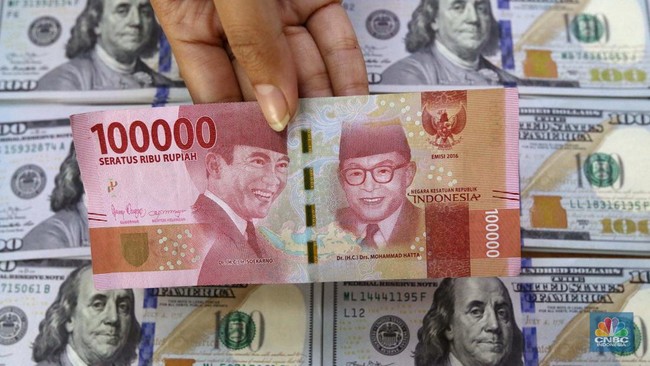
Jakarta, CNBC Indonesia - Bank Indonesia, the Finance Minister, and the DPR RI have voiced their opinions on the rupiah exchange rate hitting its all-time weakest position at Rp17,090 per US dollar at the close of trading on Tuesday (7/4/2026).
Finance Minister Purbaya Yudhi Sadewa stated that he believes Bank Indonesia can maintain the stability of the Garuda currency.
“If we leave the rupiah to the central bank, to the experts. I believe they can fix it,” said Purbaya when met by the media on Tuesday (7/4/2026).
According to him, the rupiah exchange rate simulation in the macro assumptions has been adjusted. Currently, he assesses that the level is still in line with the government’s scenario.
“So it’s still within the scenario,” he said.
Meanwhile, Bank Indonesia (BI) stated that the weakening of the rupiah exchange rate against the US dollar is influenced by global sentiment. BI assured that it is in the market to maintain rupiah stability.
This was conveyed by BI Senior Deputy Governor Destry Damayanti in a written statement on Tuesday (7/4/2026).
Destry explained that rupiah stability is currently the central bank’s top priority. Global uncertainty triggered by the war in the Middle East continues, so it must be anticipated through various policies.
“In the midst of very high global uncertainty, stability is currently the top priority for Bank Indonesia (BI). To that end, BI will optimise the use of all monetary operation (OM) instruments it has and also OM policies to maintain exchange rate stability,” said Destry.
BI consistently and measuredly conducts interventions in the spot market, Domestic Non-Deliverable Forward (DNDF), and Non-Deliverable Forward (NDF) in the offshore market.
Fundamentally, the ongoing war causes a rise in commodity prices. Indonesia faces pressure from the increase in world oil prices. On the other hand, Indonesia benefits from the rise in coal, nickel, and other prices.
“Indonesia’s position as an exporting country can provide a positive effect on our economy, thus offsetting the exchange rate pressure due to this escalation,” she concluded.
On the other hand, Chairman of DPR RI Commission XI Mukhamad Misbakhun revealed the negative effects of the rupiah exchange rate above Rp17,000 per US dollar on daily life. One of them is on goods with imported raw materials, including food ingredients.
“We also have to consider that this Rp17,000 exchange rate gives its own pressure. Because some domestic production components, most of their raw materials are imports,” said Commission XI Chairman Mukhamad Misbakhun on CNBC Indonesia on Tuesday (7/4/2026).
Misbakhun said that one of the processed food products potentially affected by the rupiah exchange rate pressure against the US dollar is instant noodles. He said that instant noodles are produced from plant raw materials that cannot be produced domestically, namely wheat.
“For example, we in Indonesia are one of the instant noodle producing countries. Our noodles come from wheat. We import wheat, because Indonesia is not a wheat producer,” said Misbakhun.
Besides wheat, he mentioned that there are several other food commodities whose domestic fulfilment still has to come from imports. Among them are meat and soybeans.
“The national meat needs, some still have to be imported. Then our soybean needs are imported. Some basic components like this, we import,” he emphasised.
He also urged Bank Indonesia (BI) to take a greater role in meeting the national foreign exchange (forex) needs. He assessed that the current approach is no longer adequate amid increasingly complex global dynamics.
According to him, BI should not only act as a monetary authority maintaining rupiah stability, but also become a liquidity provider for forex.
Misbakhun also questioned why BI did not take strategic steps to secure large amounts of forex supply from the beginning. For example, by locking in Indonesia’s annual dollar needs through long-term contracts.
“Why doesn’t Bank Indonesia become a liquidity provider for forex? How much is our annual forex need? For example, US$300 billion. Why don’t we chip in from the start to make a very large contract, US$300 billion?” said Misbakhun.
He urged Bank Indonesia to pursue a more aggressive approach. Such as through inter-country diplomatic channels.
BI, continued Misbakhun, could directly involve the head of state to discuss Indonesia’s forex needs more concretely. “Why don’t we hold a high-level meeting, for example with President Trump, Mr Prabowo, to request that liquidity?” he said.