
Rupiah Finally Shines in Asia as Won and Ringgit Tumble
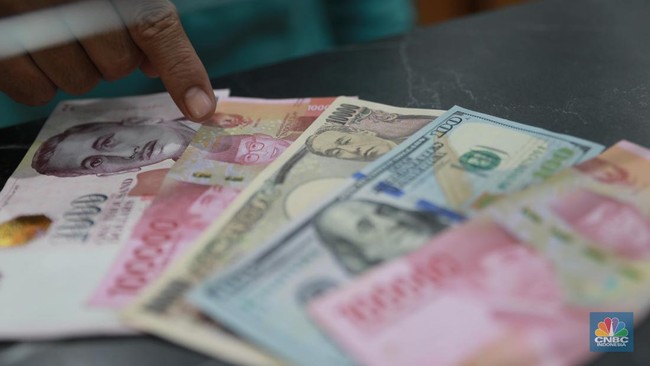
The majority of Asian currencies weakened against the United States (US) dollar in trading on Friday (5/6/2026). The pressure came amid sustained demand for the US dollar due to the renewed heating up of conflict in the Gulf region.
Referring to Refinitiv data as of 09.15 WIB, out of 10 Asian currencies monitored, seven currencies weakened against the US dollar, while three others strengthened.
The rupiah was one of the currencies still able to strengthen this morning. The Garuda currency rose slightly by 0.03% to Rp18,015/US.Despitethestrengthening, therupiah′spositionisstillabovethepsychologicallevelofRp18, 000/US.
The rupiah’s strengthening occurred alongside the Japanese yen, which rose 0.04% to JPY 159.2/US$ and the Thai baht, which strengthened 0.09% to THB 32.65/US$.
The deepest pressure this morning was experienced by the South Korean won, which weakened 0.98% to KRW 1,546.4/US.TheMalaysianringgitfollowedinsecondplacewithadepreciationof0.50.
The Taiwan dollar also came under considerable pressure after falling 0.19% to TWD 31.482/US, whilethePhilippinepesoweakened0.18.
More modest pressure was seen on the Singapore dollar, which fell 0.05% to SGD 1.284/US$. Meanwhile, the Vietnamese dong and the Chinese yuan each corrected by 0.04% and 0.01% against the US dollar.
Meanwhile, the US dollar index (DXY) was observed stagnant at 99.415 at the same time. Although it did not move much, the US dollar was still supported by safe-haven demand amidst geopolitical tensions.
Demand for the US dollar was maintained after US President Donald Trump’s efforts to stop the war in the Middle East and push for peace with Tehran faced new obstacles.
Iran-backed Hezbollah militia rejected a new ceasefire in Lebanon on Thursday. At the same time, Israel stated it would not withdraw its troops from the country.
The escalation of conflict this week, including mutual attacks between Iranian and US forces, also helped push Brent oil prices to hold above US$90 per barrel.
The rise in oil prices and geopolitical uncertainty caused market participants to seek safe assets again, including the US dollar.
This condition ultimately narrowed the room for strengthening for other countries’ currencies, including in Asia. This was visible from the majority of Asian currencies moving weaker against the US dollar this morning.