
Rupiah Finally Rebounds, Breaking Five-Day Weakening Trend Against US Dollar
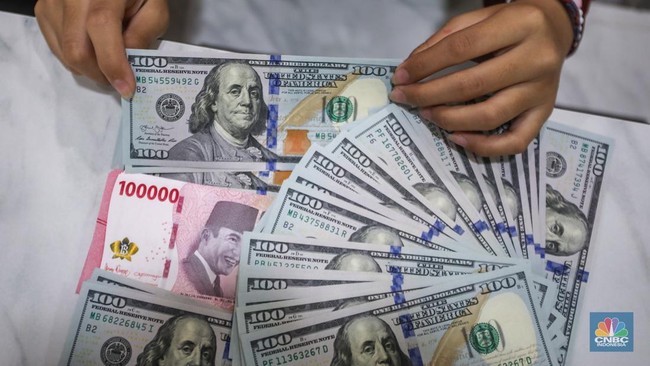
The rupiah exchange rate closed stronger against the US dollar on Wednesday’s trading (6/5/2026). According to Refinitiv data, the rupiah ended trading at Rp17,380 per US dollar, appreciating by 0.17%. This strengthening also broke the rupiah’s weakening trend that had persisted for five consecutive trading days. From the opening of trading, the rupiah moved in the green zone. The Garuda currency opened 0.34% stronger at Rp17,350 per US dollar. Meanwhile, the US dollar index or DXY, which measures the greenback’s strength against six major world currencies, also provided positive sentiment for the rupiah. At 3:00 PM WIB, the DXY was observed weakening by 0.34% to 98.111. Bank Indonesia (BI) assesses that the current rupiah exchange rate is already in an undervalued condition, or weaker than it should be based on domestic economic fundamentals. BI Governor Perry Warjiyo stated that Indonesia’s fundamental conditions are still quite strong to support rupiah stability. This is evident from first-quarter 2026 economic growth reaching 5.61%, persistently low inflation, strong foreign exchange reserves, and high credit growth. According to Perry, this combination of factors should form the basis for the rupiah to move more stably and have the potential to strengthen going forward. However, he acknowledged that the rupiah still faces short-term pressures, even briefly breaching the Rp17,400 per US dollar level. “There are two reasons: global factors, and then seasonal factors,” said Perry. From the global side, rupiah pressure is influenced by still-high oil prices, rising US interest rates, and the yield on 10-year US government bonds or US Treasury yield at a high level around 4.47%. Additionally, the US dollar remains tendentially strong, triggering capital outflows from emerging countries, including Indonesia. “And the Coordinating Minister just said there is capital flight from emerging markets including Indonesia,” said Perry. Besides global factors, Perry also highlighted seasonal factors that increase demand for US dollars in the April to June period. These needs include dividend repatriation payments, debt payments, and foreign currency requirements for Hajj pilgrims. Nevertheless, Perry emphasised that the rupiah is currently undervalued and has the potential to stabilise and tend to strengthen in the future. “But the rupiah is undervalued and will stabilise and tend to strengthen going forward. That’s number one,” said Perry.