
Rupiah Falls to Rp18,000: Is MSCI’s “Penalty” to Blame?
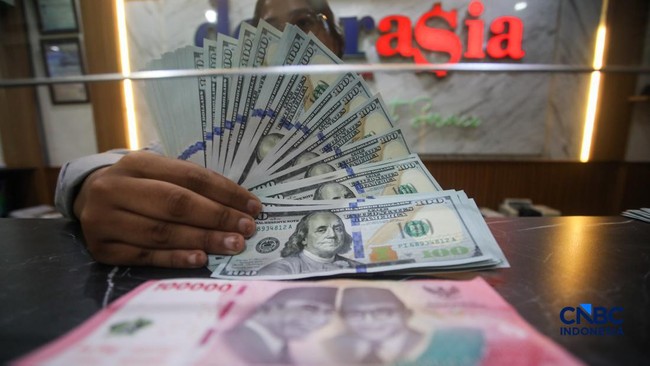
Jakarta, CNBC Indonesia — The rupiah fell to Rp18,068 per US dollar this morning. One factor behind the decline was MSCI’s proposal to downgrade Indonesia’s stock market from emerging-market to standalone-market status.
Bank Permata chief economist Joshua Pardede said MSCI’s announcement had added pressure on the rupiah by weakening investor confidence and increasing the risk of foreign capital outflows.
“The impact was visible in trading on 16 October 2026, when the Jakarta Composite Index (JCI) fell sharply by 10.10% to 5,271, while the rupiah weakened by around 0.69% to Rp18,063 per US dollar, from Rp17,938 the previous day,” he told CNBC Indonesia on Friday (16 October 2026).
Meanwhile, the yield on 10-year Indonesian government bonds rose by around eight basis points to 7.34%, reflecting greater investor caution towards Indonesian financial assets.
Joshua explained that when foreign investors sell shares and decide to withdraw their funds from Indonesia, they convert the rupiah proceeds into US dollars. This increases demand for foreign currency and puts pressure on the exchange rate.
However, not every share sale automatically results in funds leaving the country, as some investors may redirect their investments into government securities or other domestic financial instruments.
Joshua said the rupiah’s pressure was not solely due to MSCI’s announcement. It had also been exacerbated by global uncertainty, high oil prices and expectations that US interest rates would remain elevated.
“The greatest risk is that concerns over stock-market governance develop into a loss of investor confidence in Indonesia’s financial markets as a whole, so that pressure affects not only the JCI but also spreads to the rupiah and the bond market,” he said.
Joshua said the risk of further rupiah weakness remained significant if foreign investors continued reducing their holdings of Indonesian shares ahead of MSCI’s final decision in June 2027.
“In the short term, Bank Indonesia needs to strengthen rupiah stabilisation through measured foreign-exchange market intervention, optimise hedging transactions and maintain adequate banking liquidity, so that pressure in the stock market does not spread into a disruption to financial stability,” he said.
Joshua added that Bank Indonesia should begin considering an interest-rate increase to protect the rupiah from external pressure.
“An increase in the BI Rate from its current level of 5.75% should be considered if the rupiah’s decline continues, accompanied by substantial capital outflows, a fall in foreign-exchange reserves and rising inflation risks,” he said.
However, he said monetary measures alone would not be enough, as the underlying issues raised by MSCI concerned transparency of share ownership, the reliability of reported public shareholdings and oversight of irregular transactions.
“The Financial Services Authority (OJK) and the Indonesia Stock Exchange must quickly demonstrate tangible governance improvements that international investors can trust,” he concluded.
MSCI and investor confidence in Indonesia
Trimegah Sekuritas Indonesia chief economist Fakhrul Fulvian said MSCI’s decision to open a consultation on potentially reclassifying Indonesia from an emerging market to a standalone market should be taken seriously.
He said the issue warranted serious attention because MSCI’s concerns had not arisen suddenly.
“This is not simply a matter of the JCI falling. When MSCI begins questioning whether Indonesia still qualifies for the emerging-market group, what is being tested is confidence in our market institutions,” Fakhrul said on Friday (16 October 2026).
“So, in my view, this is no longer just a free-float issue. It is a matter of trust.”
Fakhrul said Indonesia needed to respond to the criticism with much stronger transparency measures.
He said global investors needed to know who a company’s beneficial owners were, how much of its stock was genuinely available to the public, whether ownership was concentrated, and whether the information could be consistently verified.
“Global markets are not satisfied with simply seeing the reported free-float figure. They want to know whether that free float is genuinely investable and whether the ownership structure is sufficiently transparent.”
Fakhrul also argued that regulatory improvements would not be enough without strong enforcement.
Investors needed assurance that rules were applied consistently, including in cases involving potentially manipulative transactions, opaque ownership structures and conduct that could undermine market integrity.
“Governance is not just the number of rules in place. Governance is investors’ confidence that those rules are actually enforced.”
He said Indonesia should use the MSCI episode as an opportunity to strengthen market surveillance, enforcement, disclosure, minority-investor protection and corporate accountability.
“Regulation without enforcement does not create trust.”
Source: jawawa.id (https://jawawa.id/newsitem/rupiah-falls-to-rp18-000-is-mscis-penalty-to-blame-1792126230)
Originally published by CNBC Indonesia (https://www.cnbcindonesia.com/market/20261016102525-17-776751/rupiah-tembus-rp18000-inikah-efek-hukuman-msci), translated from Indonesian