
Rupiah Falls to IDR 17,600 per US Dollar, Economist Highlights This Issue
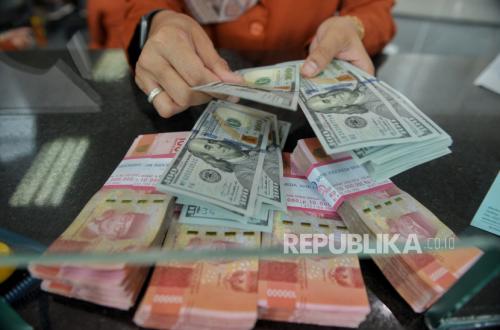
REPUBLIKA.CO.ID, JAKARTA – Economist from Hasanuddin University, M Syarkawi Rauf, analysed the link between risk premium and the extreme depreciation of the Rupiah throughout 2026. According to him, the Rupiah’s weakening is partly due to Indonesia’s high risk premium. As information, risk premium is the additional return expected by investors as compensation for taking higher risks compared to investments considered safe.
“Since January 2026, Indonesia has experienced a phenomenon of increasing risk perception, as reflected in the high country risk premium, which is around 2.46 percent. This is higher than Malaysia’s 1.55 percent and Thailand’s 2.07 percent,” said Syarkawi in a statement received by Republika, quoted on Friday (15/5/2026).
Similarly, Indonesia’s equity risk premium reached 6.69 percent since January 2026. This figure is much higher than Malaysia’s 5.78 percent and Thailand’s 6.30 percent.
“High risk perception has caused the Rupiah exchange rate to weaken and even reach its weakest point in history,” he said.
The Rupiah has passed the IDR 17,500 per US dollar level on Tuesday (12/5/2026). It even touched IDR 17,600 per US dollar during trading on Friday (15/5/2026).
Syarkawi said this contrasts with the movement of other ASEAN currencies, such as the Malaysian Ringgit and the Thai Baht, which have lower risk perceptions. The Malaysian Ringgit exchange rate against the US dollar has tended to strengthen since January 2026 until now.
The Thai Baht currency, with a lower country risk premium than Indonesia, has weakened by only about 1.07 percent compared to last month and 2.49 percent in the last 12 months.
“Furthermore, Indonesia’s high equity risk premium has caused the Jakarta Composite Index (JCI) to fall drastically from its all-time high on January 19, 2026, of 9,147.5 to only 6,853.5 on May 12, 2026. Heading towards its lowest point in the last five years of 6,272.0 on March 17, 2025,” he explained.
This contrasts with the Malaysian stock price index (FKLCI), which has a lower equity risk premium than Indonesia and has increased to 1,751 points on Tuesday (12/5/2026). This figure increased by about 0.30 percent compared to the previous trading session on Monday (11/5/2026), or increased by 10.36 percent compared to last year (year on year/yoy).
Similarly, the Thai stock price index, SET 50, with a lower equity risk premium than Indonesia, weakened to only 974 points on Tuesday (12/5/2026). This figure decreased by about 0.04 percent compared to the stock price index on Monday (11/5/2026). However, the index is 23.32 percent higher than last year (yoy).
According to Syarkawi’s analysis, the high risk premium of the Rupiah can also be seen in the anomaly of the Rupiah exchange rate depreciation against the US dollar in recent days. Especially since the release of the Central Bureau of Statistics (BPS) regarding the national economic fundamentals, namely Indonesia’s economic growth reaching 5.61 percent, the highest since 2023.
“This means that the extreme depreciation of the Rupiah against the US dollar does not align with the movement of national macroeconomic fundamental indicators, especially the interest rate differential, economic growth, and inflation between Indonesia and the US,” he said.
“The phenomenon of extreme depreciation of the Rupiah against the US dollar and the sharp decline in the JCI since January 2026 more reflects the high risk premium of the national economy,” he added.