
Rupiah Edges Slightly Stronger, US Dollar Exchange Rate Falls to Rp17,905
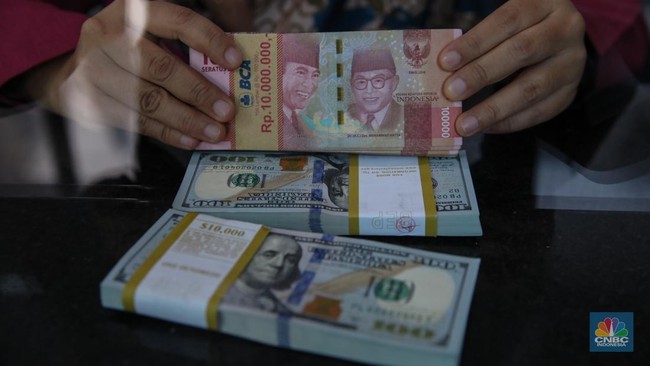
The Garuda currency managed to reverse its fortunes and closed stronger against the United States (US) dollar ahead of the weekend. The rupiah received a positive boost amid a weakening of the US dollar index in global markets.
Referring to Refinitiv data, the rupiah exchange rate ended trading on Friday (26/6/2026) with a 0.06% gain at the level of Rp17,905/US$.
This position was the opposite of the opening trade this morning. At the opening, the rupiah had weakened by 0.20% to the level of Rp17,950/US$.
Throughout today’s trading, pressure on the rupiah even deepened at one point. The Garuda currency briefly touched its weakest daily level at Rp17,985/US, justahair′sbreadthfromthepsychologicallevelofRp18, 000/US.
However, the rupiah managed to trim its losses and reversed course to strengthen by the close of trading.
Meanwhile, the US dollar index (DXY), which measures the greenback’s strength against six major world currencies, was observed correcting by 0.08% to position 101.340 at 15.00 WIB.
The rupiah’s movement in today’s trading occurred amidst the dynamics of the US dollar in global markets. The US dollar index had temporarily halted a three-day strengthening rally during Thursday’s trading.
The DXY moved down from its strongest level since May 2025, although it remains on track for a second consecutive weekly gain since the Middle East conflict heated up again at the end of February.
Market participants are also still scrutinising United States inflation data. The Personal Consumption Expenditures Price Index, or PCE, which is the US central bank’s preferred inflation measure, rose 4.1% year-on-year in May 2026.
This increase is in line with economists’ expectations and indicates that cost-of-living pressures in the US remain high, especially after the Middle East conflict also helped push up energy prices.
Domestically, the government is seeking to reduce dependence on the US dollar. One such effort is through a plan to issue Chinese yuan-denominated debt securities, or Panda Bonds.
The Ministry of Finance’s Acting Director General of Financial Sector Stability and Development, Herman Saheruddin, said the issuance of Panda Bonds is part of diversifying the government’s financing sources.
“The reason for issuing Panda Bonds is to seek other sources of financing, or it can be said as diversification. So, with this diversification, the hope is that the risk to our state budget burden from debt financing sourced from exchange rate risk can be diversified, and we can reduce the impact of dependence on the US dollar,” Herman said when met by reporters at his office on Thursday (26/6/2026).
With more diverse financing sources, pressure from US dollar fluctuations on the state budget is expected to be more limited.
Herman assessed that China is one of the attractive countries because it has demand for Indonesian debt securities at prices that are still in line with the national economic fundamentals.
Previously, Finance Minister Purbaya Yudhi Sadewa also emphasised that Panda Bonds are strategic as they are part of the government’s debt securities diversification efforts.
This scheme can also use Local Currency Transactions, or LCT, so there is no need to depend on conversion to the US dollar.