
Rupiah Depreciation and Gas Price Surge Further Squeeze Manufacturing
The burden on the manufacturing industry is being further aggravated by the weakening of the rupiah exchange rate, given that domestic gas purchase transactions still must use US dollar denominations.
Indonesian Ceramic Industry Association (Asaki) Chairman Edy Suyanto stated that the specific natural gas price policy (HGBT), in place since 2020, had been a saviour that revived the national ceramics industry. At the start of the programme, the gas price of 6 US dollars per million British thermal units (MMBTU) successfully provided space for the industry to increase investment and expand production capacity.
However, Edy lamented the current situation where the industry is instead faced with gas supply issues. Furthermore, the HGBT tariff has now been pushed up to 7 US dollars per MMBTU. According to him, this price adjustment is actually still tolerable for business actors, provided that the gas supply in the field is available according to needs.
The problem is that the industry’s burden is increasingly weighed down by the depreciation of the rupiah exchange rate, considering that purchase transactions for gas under the HGBT scheme still must use US dollar denominations. This condition is what Edy considers to be triggering a double squeeze on the national ceramics industry’s production cost structure.
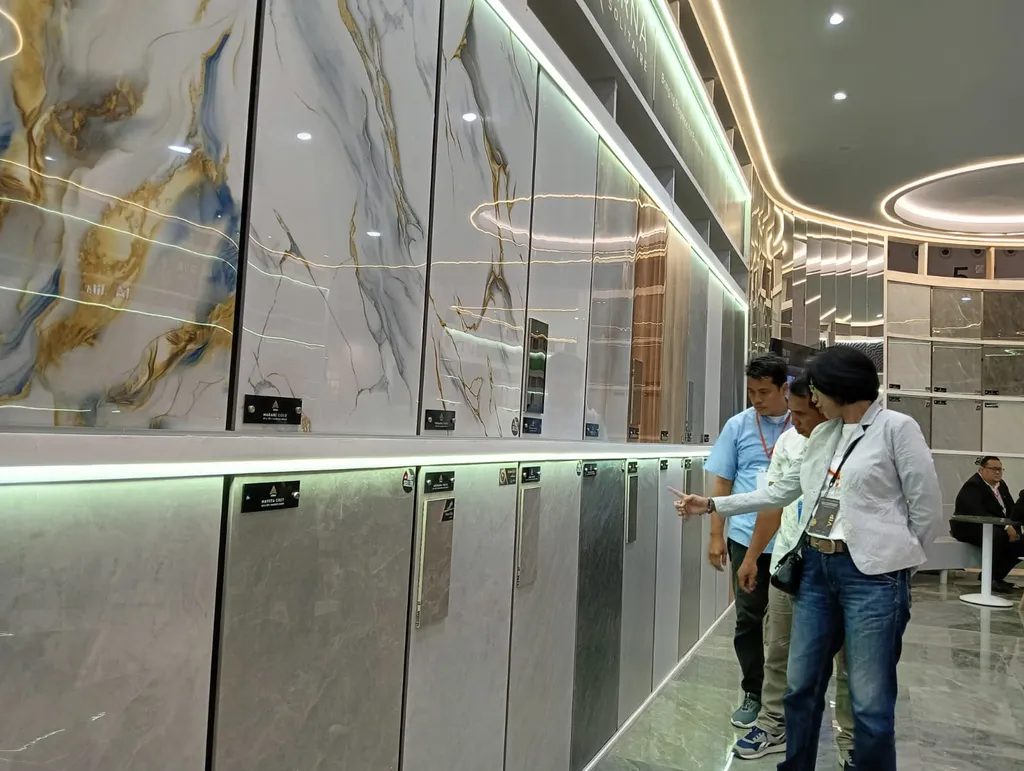
“So, one, the gas price goes up. We are battered by this. Two, we pay for gas using US dollars. So, just imagine, these are two impacts. That is why it is like adding insult to injury,” Edy said on the sidelines of the 11th Keramika Expo Indonesia at NICE PIK 2, Tangerang, Banten. He complained that amidst the weakening rupiah, paying in US dollars is very burdensome for industry players.
“Why not just pay using rupiah? This gas is from Indonesian earth. The transactions are also domestic. Why must we use USD? We have complained about this repeatedly. Our hope is to use rupiah,” he continued.
Edy further explained that the problem is becoming more complex and challenging because the HGBT gas supply received by the industry only meets 40 to 45 per cent of needs. For the remainder, companies must incur additional costs to fulfil production requirements. The supply shortfall must be met through regasified LNG with an expensive price of around 21 US dollars per MMBTU. Consequently, the average gas price paid by the ceramics industry currently reaches around 15 US dollars per MMBTU, more than double the HGBT price.
“If averaged out, the ceramics industry pays around 15 US dollars per MMBTU for gas. At that price, it is feared this will threaten utilisation rates. Secondly, our competitiveness and what we face is a onslaught of imports that will come in,” Edy said.
Despite facing heavy challenges, Edy continued, companies cannot simply raise ceramic product prices for consumers due to considerations over purchasing power that has not yet recovered. The steps taken currently are implementing internal efficiencies, increasing productivity, and suppressing company profit margins. “We cannot just pass the cost increase onto consumers because public purchasing power must also be maintained. Besides that, the threat of imported products is still very large,” Edy stated.
He estimates the current surge in energy costs could potentially erode industry profit margins by 3 to 4 per cent. This figure is quite significant considering the average business margin in the ceramics sector and several other manufacturing industry sectors is only 9 to 10 per cent.
According to Edy, this condition has caused energy costs to rise sharply. If at the beginning of the HGBT implementation the energy cost portion was only 27 to 28 per cent of total production costs, currently the figure could potentially soar past 45 per cent. Gas costs account for about 40 per cent of total ceramics production costs.
Edy assessed that this situation puts the Indonesian industry in a severe challenge compared to competitor nations in the ASEAN region. Although also experiencing increases, ASEAN countries still remain lower compared to Indonesia. For example, the industrial gas price in Thailand is currently around 12 US dollars per MMBTU, while Malaysia is at 10 to 11 US dollars per MMBTU. “Indonesia is a gas-producing country, yet the price we pay is actually more expensive compared to neighbouring countries that import it,” he stated.
Meanwhile, Indonesian Employers’ Association (Apindo) Chairwoman Shinta W Kamdani assessed that the weakening of the rupiah exchange rate is a serious concern for the business world. The impact is seen not only from the exchange rate level itself, but from the transmission of that weakening into production cost structures, financing costs, business margins, and certainty in making business decisions.
“This pressure on the rupiah has also been occurring gradually since the beginning of the year so that its impact on the real sector is now increasingly felt,” Shinta said. For the manufacturing industry, the rupiah’s weakening becomes very sensitive because the national production structure still has a fairly high dependence on imported raw materials and intermediate goods, around 70 per cent. “That means, when the rupiah weakens, imported input costs increase and directly enter the cost of goods sold,” she stated.
In the current situation, business actors are undertaking various mitigation measures to maintain operational sustainability. These strategies include operational efficiency, controlling non-essential costs, strengthening inventory management, adjusting supply sources, and temporarily postponing non-urgent expansions or new investments. In addition, companies are beginning to strengthen market and supply chain diversification. For industries where it is possible, business actors are striving to increase the use of local raw materials to reduce exposure to imported inputs and exchange rate volatility.