
Rupiah Continues to Weaken, US Dollar Closes Near Rp18,000
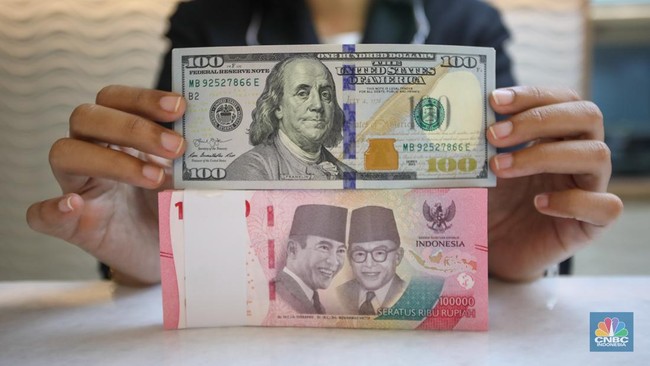
Jakarta, CNBC Indonesia - The rupiah again closed lower against the United States (US) dollar in today’s trading. The rupiah was unable to capitalise on the greenback’s weakening momentum in global markets.
According to Refinitiv, the rupiah exchange rate at the close of trading on Thursday (2/7/2026) weakened by 0.32% against the greenback, settling at Rp17,988/US.ThispositionleavestherupiahjustonestepawayfromthepsychologicallevelofRp18, 000/US.
The rupiah’s weakening was evident from the opening of trade. The Garuda currency immediately opened down 0.14% against the US dollar. Throughout today’s trading, the rupiah moved in a range of Rp17,960/US$ to Rp17,995/US$.
Meanwhile, the US dollar index (DXY), which measures the greenback’s strength against six major world currencies, was observed weakening 0.21% to 101.177 as of 15.00 WIB.
The rupiah’s journey in today’s trading indicates that pressure on the Garuda currency remains quite strong. A weakening DXY typically opens room for appreciation for other countries’ currencies, including the rupiah. However, this room could not be utilised. The rupiah instead remained under pressure and moved closer to the Rp18,000/US$ level.
One sentiment weighing on the rupiah came from Indonesia’s trade balance data. The Central Statistics Agency (BPS) reported on Wednesday (1/7/2026) that Indonesia’s trade balance recorded a deficit in May 2026.
BPS recorded Indonesia’s trade balance at a deficit of US$1.61 billion in May 2026. The deficit occurred because the export value was recorded at US$23.20 billion, while imports reached US$24.81 billion.
This record drew market attention because Indonesia’s trade balance has returned to the red zone after six years of surplus. The May 2026 deficit is the first since April 2020. At that time, Indonesia also recorded a trade deficit of US$0.38 billion. Thus, Indonesia’s 72-month trade surplus streak since May 2020 has officially been broken.
Looking further back, the May 2026 deficit is also the deepest since April 2019. During that period, Indonesia’s trade balance recorded a deficit of US$2.33 billion.
‘The absence of domestic fuel price adjustments to curb demand, coupled with high global oil prices and a weaker rupiah, weighed on the trade balance. Exports fell 5% year-on-year, mainly due to weaker shipments of palm oil, iron and steel, and machinery, although nickel exports remained resilient,’ wrote DBS senior economist Radhika Rao.
The good news is that easing geopolitical tensions have caused benchmark global oil prices to fall sharply in June. She assessed that this condition could potentially reduce pressure on Indonesia’s trade balance starting from the third quarter of 2026.