
Rupiah Collapse Puts Six Issuers in the Red Zone
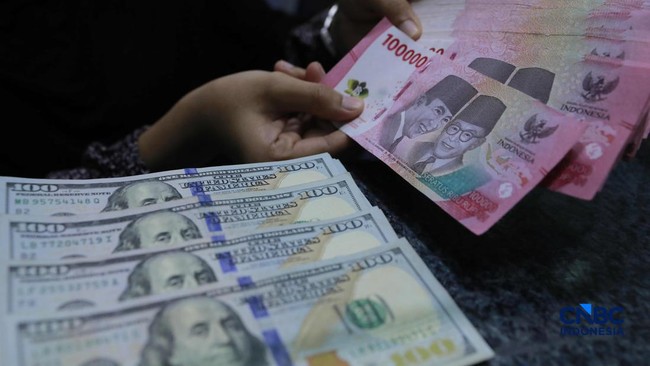
The rupiah continues to crumble against the United States (US) dollar, leaving it increasingly vulnerable to further weakening. This depreciation has become a burden for companies carrying substantial debt denominated in US dollars.
Citing Refinitiv data, as of 11.00 Western Indonesian Time (WIB) today, Friday (5/6/2026), the rupiah was perched at Rp18,025/US$, marking an 8.04% depreciation year-to-date. This position is once again the currency’s weakest level on record.
This situation has been triggered by a barrage of negative sentiment in global markets, ranging from global geopolitical uncertainty and the potential for rising inflation to outflows occurring in the domestic financial market, affecting both equities and bonds.
This imposes significant costs on businesspeople or companies involved in import businesses, as the expense of supplying raw materials will soar due to exchange rate differentials. Other companies that also tend to suffer when the rupiah weakens are those holding liabilities denominated in US dollars and other currencies.
Below are several issuers vulnerable to losses from the rupiah’s decline, along with a comparison between when the rupiah first breached Rp17,110/US$ and the current rate of Rp18,010/US$.
PT Indofood CBP Sukses Makmur Tbk (ICBP) is among the issuers exposed to the impact of rupiah exchange rate fluctuations. According to its financial report as of the end of 2025, ICBP’s total foreign currency liabilities as of 31 December 2025, adjusted to an exchange rate of Rp17,110 per US dollar, stood at approximately Rp48.60 trillion, now rising to Rp51.12 trillion.
The largest component originates from Global Bonds worth US$2.75 billion, equivalent to Rp47.05 trillion, now rising to Rp49.53 trillion. Other US dollar obligations, including trade payables, were recorded at US$46.41 million, equivalent to Rp794.07 billion, now rising to Rp835.84 billion.
Remaining liabilities in other currencies, such as the Saudi Riyal, Turkish Lira, and Japanese Yen, have a cumulative total value of around Rp754.70 billion. As of the report period, no formal hedging policy had been implemented to mitigate the risk of these foreign currency exchange rate fluctuations.
Next is ICBP’s parent company, PT Indofood Sukses Makmur Tbk (INDF), which also has exposure to rupiah fluctuations. INDF’s total foreign currency liabilities as of 31 December 2025, adjusted to an exchange rate of Rp17,110 per US dollar, reached approximately Rp56.66 trillion, now rising to Rp58.53 trillion.
The largest portion comes from long-term liabilities (including Global Bonds and bank loans) worth US$2.84 billion, equivalent to Rp48.52 trillion, now rising to Rp51.15 trillion. In addition, there are short-term bank loans worth US$384.93 million (equivalent to Rp6.58 trillion, now rising to Rp6.93 trillion), as well as trade payables and other operational liabilities in US dollars amounting to US$55.04 million (equivalent to Rp941.73 billion, now rising to Rp991.27 billion).
Obligations in non-USD currencies, such as the Japanese Yen, Saudi Riyal, and Turkish Lira, have a cumulative value of about Rp620 billion. The company was recorded as having no formal hedging policy for these exchange rate fluctuation risks during the relevant reporting period.
Property issuer PT Modernland Realty Tbk (MDLN) is the next company exposed to rupiah fluctuation conditions. As of the end of 2025, MDLN’s total foreign currency liabilities as of 31 December 2025, adjusted to an exchange rate of Rp17,110 per US dollar, were recorded at approximately Rp5.28 trillion, now rising to Rp5.56 trillion.
All these obligations are in US dollar denominations, with the largest portion coming from bond debt totalling US$274.51 million, or equivalent to Rp4.94 trillion, maturing in April 2027. Other debt components include a syndicated loan of US$31.30 million (equivalent to Rp535.54 billion, now rising to Rp563.71 billion) maturing in January 2027, and accrued expenses of US$3.05 million (equivalent to Rp52.19 billion, now rising to Rp54.93 billion). To mitigate exchange rate fluctuation risks, the company uses derivative instruments in the form of currency forward contracts and conducts routine oversight of economic conditions.
From the telecommunications sector, PT XLSmart Telecom Sejahtera Tbk (EXCL) recorded total foreign currency liabilities at the end of 2025 of Rp1.15 trillion, now rising to Rp1.21 trillion. This portion originates from trade payables to suppliers totalling US$67.12 million (equivalent to Rp1.15 trillion, now rising to Rp1.20 trillion) and accrued expenses of US$0.22 million (equivalent to Rp3.76 billion, now rising to Rp3.96 billion).
Unlike the previous period, the company no longer recorded long-term bank loans or bonds in foreign currencies at the end of 2025. Current exchange rate risk exposure primarily stems from payment obligations to suppliers for capital expenditure needs. To mitigate this risk, management conducts routine supervision and evaluation through the treasury function in accordance with policies approved by the Board of Directors.
In the energy sector, PT Harum Energy Tbk recorded total foreign currency liabilities in US dollar denomination as of 31 December 2025, adjusted to an exchange rate of Rp17,110 per US dollar, at approximately Rp24.58 trillion, now rising to Rp25.88 trillion (equivalent to US$1.43 billion). HRUM uses the US dollar as its functional and financial statement presentation currency, thus this value represents the entire portion of US dollar-denominated debt held by the corporate group.
The largest component of these US dollar obligations comes from payables to non-controlling shareholders of subsidiaries totalling US$628.97 million (equivalent to Rp10.76 trillion, now rising to Rp11.33 trillion). Another major component is long-term bank loan facilities, including the portion due within one year, totalling US$616.67