
Rupiah Closes Weaker at Rp18,364 per US Dollar on Thursday
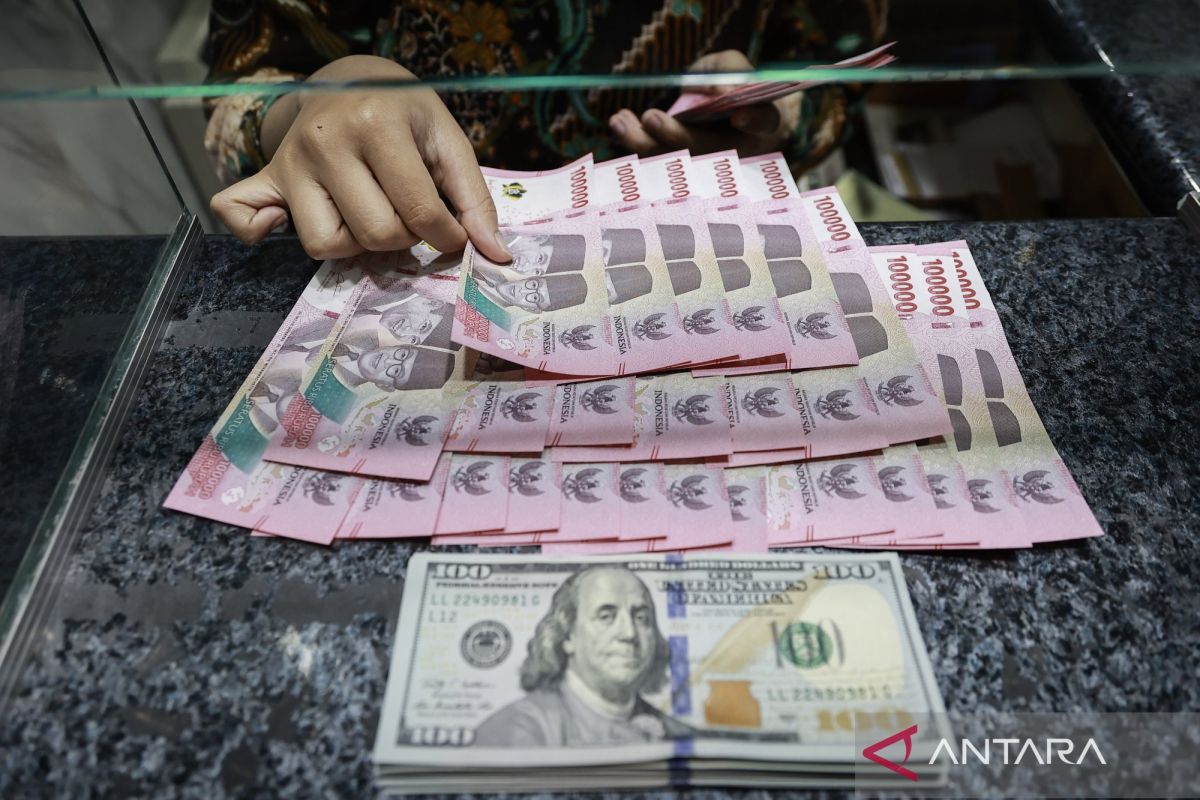
Jakarta (ANTARA) – The rupiah exchange rate closed 32 points, or 0.17%, lower at Rp18,364 per US dollar on Thursday afternoon.
Money market analyst Ibrahim Assuabi said that, domestically, a proposed US tariff of up to 18% on Indonesian products should be a concern, as it could affect the competitiveness of national exports.
If introduced, the tariff would make Indonesian products more expensive in the US market and could consequently curb demand. Export-dependent manufacturing sectors, including textiles, footwear, electronics and other industrial products, should be alert to the potential effects on orders and production.
“This policy could add to the pressure if Indonesia’s exports to the US decline. Lower export earnings could affect the domestic supply of dollars, while trade uncertainty could also undermine investor confidence,” Ibrahim said in a statement in Jakarta on Thursday.
However, the effects may not be felt immediately, as the tariff remains a proposal and consultations are set to continue until 2027. The government should strengthen trade diplomacy with the US, improve industrial competitiveness and seek alternative export markets to reduce reliance on a single country.
With the rupiah under pressure, Ibrahim said the government and Bank Indonesia (BI) should strengthen coordination and take concrete steps to maintain exchange-rate stability.
BI should intervene in the market in a measured way, ensure adequate foreign exchange reserves and control inflation without relying too heavily on interest-rate rises, which could burden businesses and the public.
The government, meanwhile, should maintain fiscal discipline, control state spending, strengthen domestic industry, reduce import dependence and increase exports to boost foreign exchange supplies.
“Most importantly, the government must provide policy certainty and maintain investor confidence. Rupiah weakness cannot be addressed through BI intervention alone; it also requires strong economic fundamentals and consistent government policies,” Ibrahim said.
Externally, pressure on the rupiah has also come from rising geopolitical tensions in the Middle East, particularly around the Strait of Hormuz.
The United Kingdom Maritime Trade Operations (UKMTO) reported that three more vessels had been struck by projectiles while travelling east through the Strait of Hormuz.
Separately, Iran’s Fars news agency reported that another tanker had struck a mine.
Tehran has threatened to tighten its control over the waterway until Washington lifts its naval blockade, eases sanctions and releases frozen Iranian assets. The US is also seeking concessions from Iran over its nuclear programme.
US Vice-President JD Vance met Qatar’s Prime Minister, Sheikh Mohammed bin Abdulrahman Al Thani, to discuss regional developments. However, differences between Washington and Tehran continue to hamper negotiations.
Tensions have also risen after Iran-aligned Houthi rebels reportedly stepped up attacks on Saudi Arabia. The attacks, involving four drones, targeted the Ras Tanura oil refinery and two ports on the Red Sea.
“Bahrain also reported Iranian attacks on civilian industrial facilities, while Iran’s Revolutionary Guard claimed to have launched missile and drone attacks on US military positions in the kingdom,” he said.
Against this backdrop, Ibrahim forecast that the rupiah would fluctuate with a weakening bias in Friday’s trading (27 November), in a range of Rp18,360 to Rp18,420 per US dollar.
Source: jawawa.id (https://jawawa.id/newsitem/rupiah-closes-weaker-at-rp18-364-per-us-dollar-on-thursday-1795690351)
Originally published by Antara (Indonesian) (https://www.antaranews.com/berita/5880359/rupiah-kamis-sore-ditutup-melemah-jadi-rp18364-per-dolar-as), translated from Indonesian