
Rupiah Closes Weaker as US Dollar Rises to Rp17,705
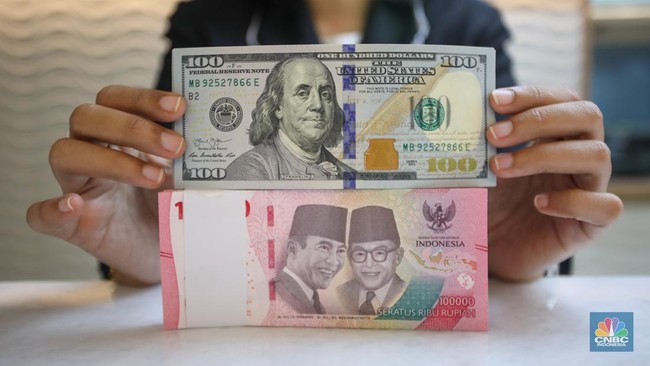
Jakarta, CNBC Indonesia - The rupiah exchange rate reversed course to weaken against the US dollar at the close of trading on Monday (24/8/2026). This depreciation also ended the rupiah’s strengthening streak over three consecutive trading days.
Referring to Refinitiv data, the rupiah closed down 0.17% or depreciated to the level of Rp17,715/US$.
Throughout today’s trading, the rupiah actually opened stronger by 0.03% at the level of Rp17,680/US$ in morning trading. However, the Garuda currency then reversed direction and weakened by 25 points from the opening position to the close.
Meanwhile, the US dollar index (DXY), which measures the strength of the greenback against six major world currencies, was observed strengthening 0.17% to position 98.969 at 15.00 WIB. The DXY’s strengthening widened compared to the morning position, which had only risen 0.03%.
The rupiah weakened as the US dollar turned stronger in today’s trading. US services activity data, which recorded the strongest growth in nearly two years, was one of the factors holding back selling pressure on the greenback.
The dollar also received support from high US government bond yields. Long-term bond yields remained around their highest levels in several decades due to concerns over government debt, inflationary pressures, and increased financing needs.
However, the dollar’s strengthening remained limited as the market monitored the US Treasury Department’s plan to increase buybacks of long-term government bonds. The policy raised concerns that efforts to suppress yields could actually weigh on the dollar.
Market participants were also awaiting details of new US sanctions against Iran as well as a speech by Federal Reserve Chair Kevin Warsh at the Jackson Hole symposium on Friday. Warsh’s remarks will be scrutinised for clues regarding the direction of US interest rates.
In addition, the rupiah remained overshadowed by the widening of Indonesia’s current account deficit. In the second quarter of 2026, the current account deficit swelled to US$12.49 billion, from US$3.58 billion in the previous quarter.
Bank Danamon Chief Economist Irman Faiz assessed that the widening current account deficit would increase Indonesia’s need for foreign capital flows to cover external financing. This condition limits the room for rupiah appreciation and makes its movement vulnerable to volatility.
According to Irman, the level of Rp18,000/US$ may still be tested again if global pressures increase or foreign capital flows are insufficient to meet external financing needs.
“Our baseline still sees USD/IDR at the end of the year in the range of Rp17,900-18,150, so Rp18,000 is not a tail-risk scenario, but is still within our fundamental range,” he said.