
Rupiah Closes Stronger, US Dollar Now Parked at Rp17,865
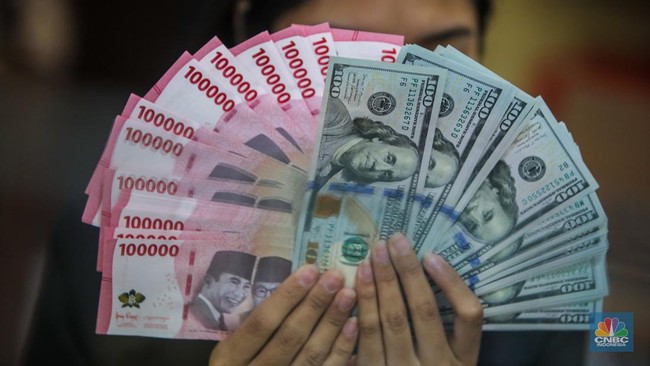
Jakarta, CNBC Indonesia - The rupiah exchange rate managed to end the final trading day of the week in positive territory. The Garuda currency strengthened against the United States (US) dollar on Friday (12/6/2026), amid ongoing student demonstrations in Jakarta.
According to Refinitiv data, the rupiah closed 0.61% higher at Rp17,865/US.ThispositionseestherupiahmovingfurtherawayfromthepsychologicallevelofRp18, 000/US and beginning to approach the Rp17,800/US$ area.
The rupiah’s strengthening was evident from the opening of trade this morning. The rupiah opened 0.42% stronger at Rp17,900/US.However, therupiah′smovementwasnotentirelysmoothasitbrieflyweakenedtoRp17, 965/US before ultimately strengthening again until the close of trading.
On the other hand, the US dollar index (DXY) as of 15.00 WIB was observed moving steadily at 99.875. In the previous session, the DXY had weakened by 0.09%.
The rupiah’s appreciation occurred alongside the weakening of the US dollar in global markets. The greenback’s correction opened room for a number of other currencies to strengthen, including the rupiah.
The US dollar had previously weakened against several major currencies after US President Donald Trump cancelled plans for a new military strike on Iran at the last minute. Trump stated that negotiations with Tehran were beginning to point towards the possibility of reaching an agreement.
Generally, the US dollar tends to strengthen when geopolitical uncertainty rises as investors seek safe-haven assets, including US government bonds. Conversely, the dollar usually weakens when hopes for peace increase and funds flow back into riskier assets.
Domestically, the rupiah’s strengthening also occurred amid ongoing student demonstrations in Jakarta. Nevertheless, the pressure from this domestic factor was not yet able to hold back the rupiah’s appreciation in today’s trading.
Senior economist Raden Pardede said the strength or weakness of the rupiah can be seen from the condition of foreign exchange reserves and the balance of payments (BOP).
“So, if we look at the rupiah, what factors determine whether it rises or falls can actually be seen from whether the foreign exchange reserves are sufficient. Then the next thing is the condition of the balance of payment,” Raden said at the KONEKSI CNBC Indonesia event, quoted on Friday (12/6/2026).
Raden explained that if the balance of payments still shows a positive condition, then the national foreign exchange reserves are also still strong. With that, the government and monetary authorities still have ammunition to maintain the rupiah’s stability.
With today’s strengthening, the rupiah closed the week with a positive result. Its next movement will be heavily influenced by the direction of the US dollar, global geopolitical developments, and market confidence in domestic resilience.