
Rupiah Closes Stronger, US Dollar at Rp17,945
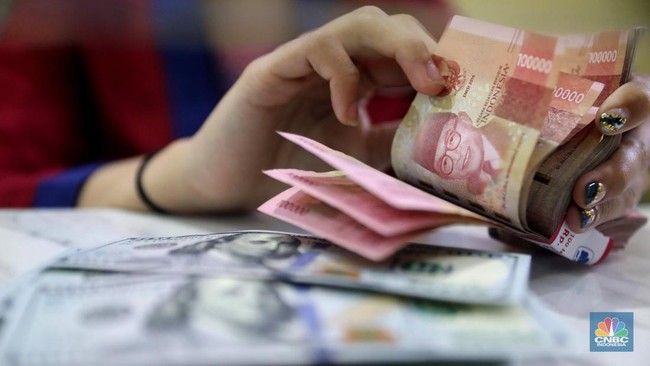
The rupiah exchange rate successfully closed stronger against the US dollar in the final trading session of this week, Friday (3/7/2026).
According to Refinitiv data, the ‘Garuda’ currency ended in the green, strengthening by 0.24% to the level of Rp17,945/US$. This appreciation simultaneously broke the trend of rupiah depreciation seen over the previous three consecutive trading sessions.
Throughout today’s trading, the rupiah moved within the range of Rp17,935-Rp17,965/US$. The strengthening of the rupiah was evident from the start of morning trading, alongside the weakening of the US dollar in the global market.
Meanwhile, the US Dollar Index (DXY), which measures the strength of the greenback against six major world currencies, was observed to have weakened by 0.13% to 100.725 as of 15:00 WIB.
The rupiah’s strength today was primarily influenced by external factors, namely the weakening of the US dollar in the global market. The greenback weakened this afternoon, continuing a sharp correction from previous trading. The DXY previously closed down 0.53%, as market expectations regarding the possibility of US central bank (The Fed) interest rate hikes in the near future subsided.
The weakening of the US dollar indicates that selling pressure on greenback-denominated assets has begun to increase. This condition has created more room for the appreciation of other currencies, including the rupiah.
Pressure on the US dollar emerged after US labour market data showed signs of cooling. US job growth in June was recorded to have slowed more deeply than expected, while payroll increases for the two preceding months were also revised downwards. Throughout June, the US economy added only 57,000 jobs, far below the market expectation of 110,000 jobs.
Weaker labour data has led the market to reweigh the chances of Fed rate hikes for the remainder of the year. This has ultimately pressured the US dollar and provided space for the rupiah to strengthen.
Meanwhile, the Chief Economist of Trimegah Sekuritas Indonesia, Fakhrul Fulvian, assessed that the current movement of the rupiah should be viewed as part of a financial market adjustment process, rather than solely a reflection of deteriorating Indonesian economic fundamentals.
“In my view, we are starting to see positive signals. Foreign investors have returned to the government bond market in recent times. This indicates that the market is beginning to appreciate the changes in policy direction implemented by the authorities, particularly in liquidity management and efforts to restore healthier price formation mechanisms in the bond market,” said Fakhrul.
According to Fakhrul, the process of rupiah stabilisation does not happen instantly. The bond market is one of the important factors as it serves as the primary gateway for foreign portfolio capital inflows.
“The rupiah is essentially waiting for larger capital inflows. To generate sustainable capital inflows, the Indonesian bond market needs to offer sufficiently attractive yields compared to the still high global risks,” said Fakhrul.
He added that Indonesia is currently moving from a phase of pressure towards a phase of stabilisation. However, this process still requires policy consistency so that foreign capital flows into the government bond market can become even stronger.