
Rupiah Closes Nearly 1% Stronger, US Dollar Parks at Rp17,690
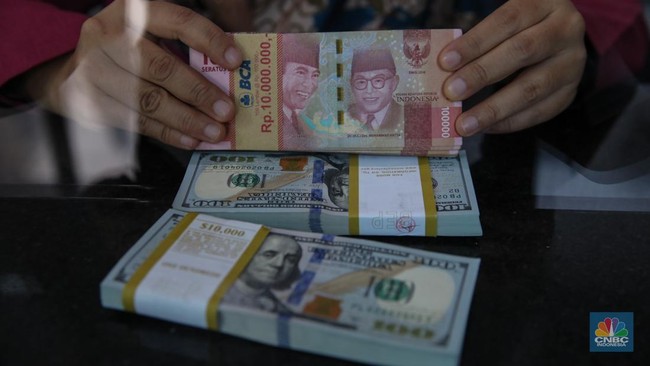
The Indonesian rupiah ended trading at the start of the week with a sharp gain against the United States dollar on Monday (15/6/2026). According to Refinitiv data, the rupiah closed 0.98% stronger at Rp17,690 per US dollar. This gain extended the positive performance seen in the last session of the previous week, when the rupiah closed 0.61% higher at Rp17,865 per US dollar on Friday (12/6/2026). Throughout today’s trading, the rupiah moved solidly in positive territory. The Garuda currency opened trading with a 0.64% gain at Rp17,750 per US dollar. The rupiah’s strengthening then increased further, briefly touching Rp17,670 per US dollar. Although the gains slightly diminished towards the close, the rupiah remained firmly in the Rp17,600s per US dollar range. Meanwhile, the US dollar index (DXY), which measures the greenback’s strength against six major world currencies, was observed weakening 0.22% to 99.531 as of 15.00 Western Indonesia Time. The rupiah’s strengthening today was supported by the US dollar’s weakness in global markets. The DXY weakened amid news that the United States and Iran had agreed on a peace deal framework. The news caused oil prices to fall and boosted demand for riskier assets. US and Iranian officials stated on Sunday local time that both countries had agreed on a framework to end the war, halt the US blockade of Iran, and reopen the Strait of Hormuz. Oil prices fell, with Brent crude correcting more than 4% to US$83.82 per barrel. Nevertheless, market participants remained cautious. US President Donald Trump told the New York Times on Sunday that if Iran fails to reach a final nuclear deal with the US, Washington could resume military strikes against Tehran or position the US as the ‘guardian of the Middle East’ in exchange for 20% of the region’s revenue. This situation ultimately reduced market appetite for the US dollar as a safe-haven asset. As demand for the US dollar declined, room for appreciation of other currencies, including the rupiah, became more open. Positive sentiment also came from increased market confidence in the stabilisation measures pursued by the government and Bank Indonesia (BI). Trimegah Sekuritas Indonesia Chief Economist Fakhrul Fulvian predicted the rupiah’s strengthening could continue next week. He said the market is beginning to see a clearer and more consistent policy direction in maintaining national economic stability. ‘I estimate the rupiah still has the potential to strengthen towards the Rp17,500 per US dollar range next week. The market is beginning to see that Indonesia’s economic authorities are willing to take the necessary steps to maintain macroeconomic stability and restore investor confidence,’ Fakhrul said. He explained that the rupiah had previously experienced significant pressure due to a combination of external factors and rising market concerns over domestic policy direction. However, most of these factors are now showing improvement. According to Fakhrul, three important steps form the foundation for the rupiah’s strengthening. First, BI has demonstrated a strong commitment to exchange rate stability through a cumulative interest rate hike of 75 basis points. This move sent a clear signal to the market that rupiah stability is a top priority while helping to increase the attractiveness of Indonesian financial assets. Second, the adjustment of fuel prices, particularly Pertamax, is beginning to improve market perception of Indonesia’s fiscal condition. Although not a popular policy, the move is seen as demonstrating the government’s courage to make necessary adjustments to maintain the sustainability of the state budget. Third, efficiency and budget adjustments in several government programmes, including the Free Nutritious Meals (MBG) and the Merah Putih Village Cooperatives (KDMP), are beginning to be read by the market as a signal that fiscal discipline is once again a priority.